If your vision gets blurry even with your glasses on, or bright light seems harsher, you may have a cataract. It is a condition that causes the eye’s natural lens to be cloudy. The good news is that cataract surgery can help remove the cloudy lens and replace it with an intraocular lens (IOL).
But what is an IOL? The intraocular lens implant is a core part of cataract surgery that affects your vision at different distances.
IOLs also determine whether you still require reading glasses, how effectively astigmatism is corrected, and how satisfied you are with your vision after surgery. Since cataracts affect each person differently, there’s no one-size-fits-all approach for these lens implants.
The surgeon will analyze your cataract condition and then recommend an IOL that will support your vision.
From this blog, you will get a clear understanding of IOLs and why they are used during cataract surgery. Additionally, you will learn the different types of IOLs, how to choose the best one, and their cost.
What Is an IOL and Why Is It Used During Cataract Surgery?
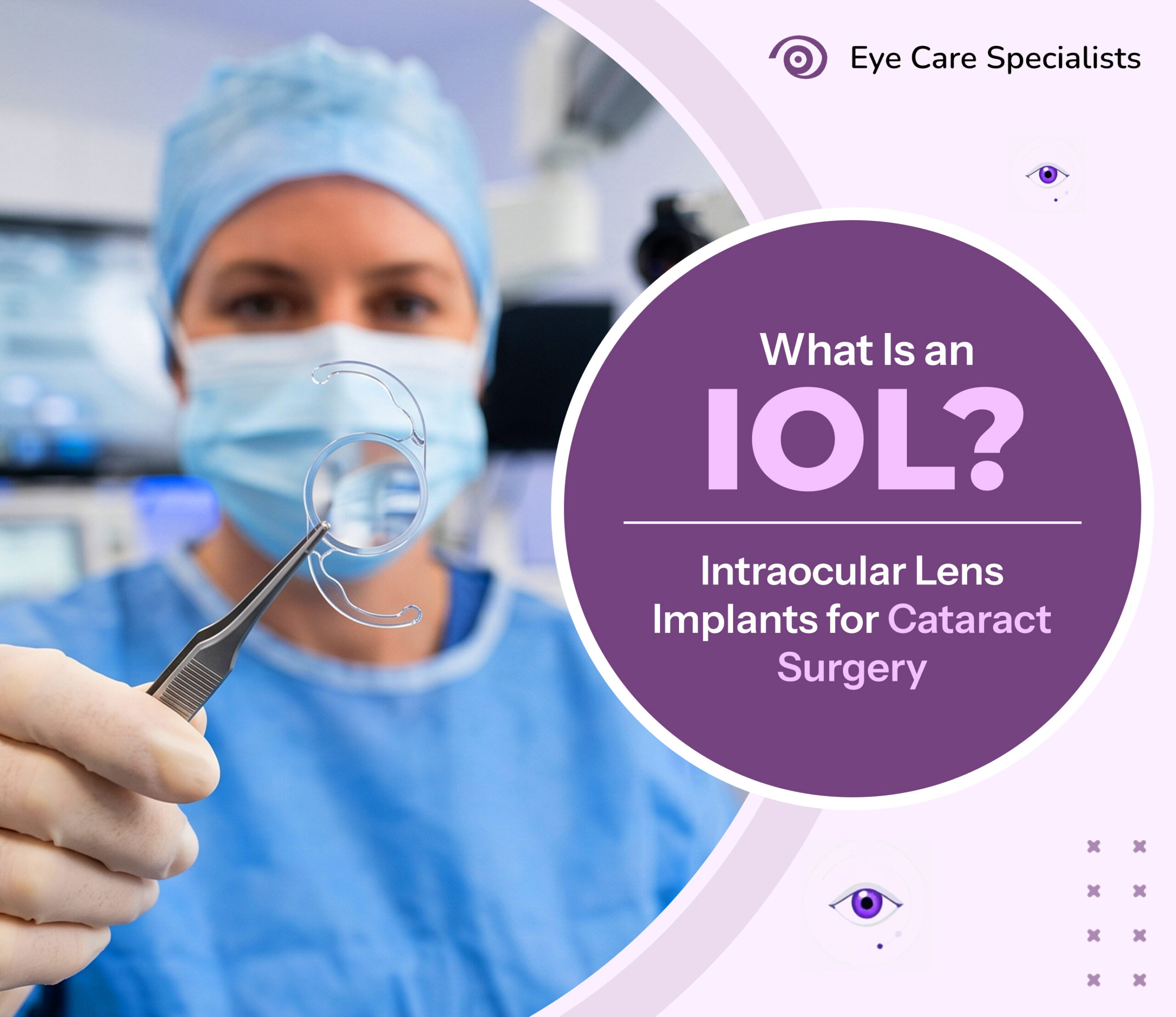
An intraocular lens (IOL) is a clear artificial lens used to replace the eye’s natural lens during cataract surgery. When a cataract occurs, the natural lens gradually becomes hazy.
As a result, light cannot pass through the eye the way it should. The cataract makes everyday activities like reading, night driving, or recognizing faces more difficult.
An IOL is used during cataract surgery because it can:
- Replace the cloudy lens that is causing blurred or faded vision.
- Restore clear vision by allowing light to pass through the eye and focus correctly.
- Improve daily activities like reading, driving, or recognizing faces, depending on your eye health.
- Support different vision needs, with lens options designed for distance, intermediate, or near vision.
- Reduce dependence on glasses for some patients, depending on the IOL type selected.
- Correct certain vision problems, such as astigmatism, with specialized lens designs.
What does IOL stand for?
IOL stands for intraocular lens. The term “intraocular” means “inside the eye”. It therefore indicates that an IOL implant is a lens that’s placed inside the eye to replace the natural lens removed during cataract surgery.
Unlike contact lenses that sit on the outside of the eye, an IOL becomes a part of the eye’s optical system. When an ophthalmologist places the lens during cataract surgery, it helps focus light onto the retina so you can see more clearly.
How does an IOL replace the eye’s natural lens?
During a cataract surgery, the ophthalmologist replaces the eye’s cloudy natural lens with an IOL. Here’s how the replacement works:
- A small incision is made in the eye: It helps your ophthalmologist safely access the natural lens.
- Removal of the cloudy lens: The surgeon uses ultrasound technology to break the cataract into minute pieces before gently removing it.
- Preservation of the lens capsule: A thin, transparent membrane is left in place to support the new lens.
- Insertion of the IOL: The folded lens is placed in the lens capsule where it slowly unfolds and takes the proper position.
- The new lens starts working: When it sits in the right position, it directs light back to the eye. As a result, you can see images more clearly as the healing process continues.
Is an IOL permanent?
Yes, an IOL is a permanent replacement for the eye’s natural lens. Once implanted, the artificial lens for cataract surgery remains in place for the rest of your life and does not require frequent change.
Made from biocompatible materials, such as silicone or acrylic, the lens will safely stay inside the eye. Unlike your natural lens, this clear artificial lens cannot develop another cataract.
However, it is crucial to understand that your vision may still change over time due to age-related eye conditions or other existing eye diseases, such as glaucoma.
In many cases, the thin membrane behind the IOL can become cloudy months/years after the cataract surgery. Such a condition is known as posterior capsule opacification (PCO).
People often mistake it for a returning cataract. But it is not a new cataract and can be treated with a quick and painless laser procedure.
How does an IOL help restore vision?
An IOL helps restore vision by replacing the cloudy natural lens damaged by cataracts. Once in place, the new lens allows light to pass through the eye again, creating a clearer image at the back of the eye.
After surgery, as the eye heals, you may experience sharper vision. It shows that the cataract surgery was a success. The level of improvement varies from one person to another. It also depends on factors such as the type of lens and the overall eye health.
Who Needs an Intraocular Lens Implant?
Anyone undergoing cataract surgery will need an intraocular lens implant. This is because when ophthalmologists remove cataracts, they also remove the natural lens.
Without a cataract lens implant, the eye cannot focus light properly, causing blurred vision. That’s why implanting an IOL is a standard part of modern cataract surgery.
However, not everyone needs the same type of lens. Your ophthalmologist will evaluate your eye health, prescription, and visual goals before recommending the most suitable option.
Do all cataract surgery patients need an IOL?
Yes, in most cases cataract patients need an IOL. As the cataract damages your natural lens, the ophthalmologist removes the cataract along with the lens.
In such a scenario, your eyes cannot focus light properly, causing distorted vision. An IOL is an artificial lens placed in the place of the natural lens, allowing light to enter and providing sharper vision.
Can IOLs be used for more than cataracts?
Most people get an IOL as a part of cataract lens replacement. However, ophthalmologists also recommend these artificial lenses to correct refractive errors like astigmatism, nearsightedness, presbyopia, and farsightedness.
Typically, Laser-Assisted In-Situ Keratomileusis (LASIK) helps correct these eye issues. It is a procedure that uses an excimer laser to permanently reshape the eye. But patients who do not qualify for LASIK receive an IOL, as advised by the doctor.
What vision problems can an IOL help correct?
An IOL can do more than replace the hazy lens during cataract surgeries. It helps correct various vision problems that can affect your eyesight before the surgery.
An IOL may help correct:
- Nearsightedness (myopia), making distant objects appear clearer.
- Farsightedness (hyperopia), which can improve your ability to focus on nearby objects.
- Astigmatism, reducing distorted vision caused by an irregularly shaped cornea.
- Age-related loss of near vision (presbyopia) can be corrected with certain premium lenses, helping some people rely less on reading glasses.
What Are the Main Types of IOLs for Cataract Surgery?
While all IOLs replace the hazy natural lens during cataract surgery, they support different vision needs. Some IOLs may provide the clearest distance vision, while others can correct astigmatism.
Choosing the right IOL for cataract surgery will help patients reduce their vision problems. Your ophthalmologist will discuss the benefits and limitations of each lens to help you make an informed decision.
The following are the main types of IOLs:
What is a monofocal IOL?
A monofocal IOL is a standard choice for most cataract patients. It provides clear vision at far distance. While it offers excellent distance vision, you will require glasses for close-up tasks such as reading or using your phone.
Pros
- Provides sharp, reliable vision at one chosen distance.
- Offers excellent contrast and image quality.
- Causes fewer visual disturbances, such as glare and halos.
- Most insurance plans and Medicare cover the cost for monofocal IOLs when used for cataract surgery.
Cons
- Corrects only one focal point.
- Most people still need glasses for near vision tasks.
What is a toric IOL?
A toric IOL is a specialized lens that is designed to treat cataracts and astigmatism. In addition to replacing the cloudy lens, it corrects the uneven curvature of the cornea that causes blurred or distorted vision.
Pros
- Corrects cataracts and astigmatism simultaneously.
- Improves the quality of distance vision.
- Reduces dependence on glasses for many daily activities.
- Eliminates the need for a separate astigmatism-correcting procedure in many cases.
Cons
- Requires precise measurements and accurate positioning during surgery.
- May not eliminate the need for reading glasses.
- Often involves additional out-of-pocket costs as many insurance plans do not cover premium lens upgrades.
What is a multifocal IOL?
A multifocal IOL is a premium lens that helps you see at different distances after cataract surgery. The lens reduces your need for glasses, but your brain may need time to adapt to how it distributes light.
Pros
- Improves vision at multiple distances, including immediate distance.
- Reduces the need for reading glasses for many patients.
- Supports greater independence from corrective eyewear for daily activities.
- Can be a good option for people with active lifestyles seeking greater visual flexibility.
Cons
- Some people notice glare and halos, especially when driving at night.
- Your brain may take several weeks or months to adjust to the lens.
- Typically costs more than a standard monofocal IOL.
What is an EDOF IOL?
An extended depth of focus (EDOF) IOL creates a consistent range of vision instead of multiple distinct focal points. It improves near vision, but you may still require reading glasses for small print.
Pros
- Delivers smooth vision across distant and nearer ranges.
- Causes fewer glares than many multifocal IOLs.
- Supports activities such as computer work and cooking with reduced reliance on glasses.
- Offers good contrast sensitivity for many patients.
Cons
- May not provide enough near vision for prolonged reading or other close-up tasks.
- Some people still need reading glasses for fine print.
What is a Light Adjustable Lens?
A Light Adjustable Lens (LAL) is a special type of IOL that can be customized after cataract surgery. The ophthalmologist uses controlled ultraviolet (UV) light treatments to adjust the lens power based on your visual needs. When you get the desired result, a final treatment locks the prescription into place.
Pros
- Allows personalized vision adjustments after surgery.
- Increases the chance of achieving your preferred visual outcome.
- Can reduce the need for glasses more effectively for some patients.
- Gives your ophthalmologist flexibility to fine-tune your vision as your eye heals.
Cons
- Requires multiple follow-up visits for adjustment treatments.
- You must wear UV-protective glasses until the final adjustment is complete.
What is an accommodating IOL?
An accommodating IOL is designed to flex within the eye’s natural muscle movements. The movement provides patients with a wider range of vision, making everyday tasks more comfortable. However, the amount of focusing power it provides varies from one person to another.
Pros
- Provides a broader range of vision than a standard monofocal IOL.
- Offers a more natural focusing experience for some patients.
- Reduces dependence on glasses for certain daily activities.
Cons
- The amount of focusing improvement varies among individuals.
- Not suitable to correct astigmatism on their own and requires a LASIK or toric IOL.
How Do You Choose the Best IOL for Cataract Surgery?
Now that you know the different types of IOLs, you can understand that each IOL meets unique vision needs. Hence, what you consider best depends entirely on your eye health, lifestyle, visual goals, and budget.
Now that you know the different types of IOLs, you can understand that each IOL meets unique vision needs. Hence, what you consider best depends entirely on your eye health, lifestyle, visual goals, and budget.
- Daily lifestyle: Think about how you spend your day. Reading, computer work, or any sports activity can influence which lenses are most suitable for your lifestyle.
- Vision priorities: Decide whether you want to reduce dependence on glasses or comfortably wear them after the surgery.
- Existing eye conditions: Conditions such as glaucoma, severe dry eyes, or macular degeneration can limit the effectiveness of some IOLs.
- Budget and insurance: Insurance covers standard lenses, such as monofocal IOLs. However, premium lenses, such as multifocal and toric lenses, often involve additional out-of-pocket costs.
What Happens During Cataract Surgery With an IOL Implant?
Cataract surgery with an IOL implant is a common and widely known outpatient procedure. It is painless and usually takes 15-30 minutes to complete cataract surgery, depending on the severity of damage to the natural lens.
Here’s what you can expect during the procedure:
- Anesthesia: Your ophthalmologist uses numbing eye drops and, in some cases, medication to help you stay relaxed and comfortable.
- Lens removal: The surgeon creates a tiny incision at the edge of the cornea to access the cataract. After that, using ultrasound energy, they break the cataract into small pieces to remove the cloudy lens.
- IOL implantation: The surgeon folds the IOL, passes it through the same small incision, and opens it once it’s inside the eye. Your surgeon positions it securely in the natural lens capsule.
- The incision begins to heal: Most small incisions seal on their own without stitches, allowing the eye to recover naturally.
- Protective measures: Once the procedure is done, you’ll rest briefly before going home with protective eyewear and eye drops to support healing.
How Much Do IOLs Cost and Does Insurance Cover Them?
The cost of IOLs typically depends on the type you choose. In most cases, Medicare and private insurance plans cover cataract surgery for monofocal IOL implants.
However, premium IOLs to correct astigmatism or reading vision may involve out-of-pocket expenses. The upgrades can range between $1,000 and $4,500 per eye. Ensure you understand your insurance network and deductibles to make the right choice.
Also, you should consult your ophthalmologist to understand which lens technology your insurance plan will cover. If you don’t have an insurance plan, the total cost for IOL implants will be around $3,000-$5,000 per eye.
Say Goodbye to Faded Vision with Eye Care Specialists
If you’ve been diagnosed with cataract, you may now be exploring cataract surgery. While doing so, you may come across the term “IOL” and wonder, “What is an IOL?” It is an artificial lens that an ophthalmologist puts in place of your natural lens during cataract surgery.
Inserting an IOL can make your vision sharper and, in some cases, give you the freedom from wearing glasses. Through a comprehensive eye exam, the ophthalmologist will recommend IOLs that align with your visual needs.
At Eye Care Specialists, we offer an experienced team to cater to your visual goals. Our ophthalmologists will evaluate your eyes and then suggest a personalized eye care plan. From cataract surgery to LASIK, our team can provide a range of ophthalmology services.
Ready to get clearer vision with an IOL? Schedule an appointment with us to explore your options and receive personalized recommendations from our team.
What is IOL: FAQ
Can you feel an IOL inside your eye?
No, you cannot physically feel an IOL inside your eye because the lens sits deep behind the iris where the natural lens used to be after the surgery. The position lacks sensory nerve endings, so it remains fixed in that place. However, you might experience mild irritation during the first few days of recovery, which is perfectly normal.
Can an IOL get dirty or cloudy over time?
No. An IOL does not get dirty or cloudy. However, months or even years after cataract surgery, the thin membrane behind the lens may become cloudy, causing blurry vision similar to a cataract. If the discomfort worsens, you should visit your ophthalmologist for a quick, painless laser treatment.
Will colors look different after getting an IOL?
Yes, after getting an IOL during cataract surgery, you may notice colors appear brighter and more vibrant. Cataracts often develop a yellow or brown tint that gradually dulls colors. Once an ophthalmologist replaces the cloudy lens with a clear IOL, more natural light reaches the retina, and you can see colors more accurately.
Can you have an MRI or CT scan with an IOL?
Yes, it is generally safe to undergo an MRI or CT scan with an IOL. Modern IOLs are made from non-magnetic, biocompatible materials such as acrylic and silicone that do not interfere with imaging tests. If you have questions about your specific lens, let your healthcare provider know before the scan.
Can both eyes receive different types of IOLs?
Yes, both eyes can receive different types of IOLs to meet a patient’s specific vision needs. Your ophthalmologist may recommend a toric IOL to correct astigmatism in one eye while a standard monofocal IOL to reduce blurry vision caused by the cataract.
What happens if I choose the wrong IOL?
If you choose the wrong IOL, it can lead to blurry vision, refractive errors, glares, or halos. After the cataract surgery, you can schedule a visit with the ophthalmologist and let them know about your vision problems. Based on the severity and lens type, they would recommend corrective glasses, LASIK, or secondary surgery to replace the IOL.
Do IOLs protect your eyes from UV light?
Yes, most modern IOLs include a built-in UV filter to block harmful ultraviolet rays from reaching the eye. Some lenses also block certain blue light wavelengths, although their benefits may vary depending on the lens design and individual patient needs.
Can dry eye affect IOL measurements?
Yes, dry eye can significantly affect the accuracy of IOL measurements. An unstable tear film may alter the corneal shape, leading to inaccurate calculations. If you have dry eye, your ophthalmologist may recommend treating it before surgery.
Do people with diabetes need special consideration before choosing an IOL?
Yes, diabetes can affect several parts of the eye, including the retina, which plays a crucial role in vision after cataract surgery. Before recommending an IOL, your ophthalmologist will examine your eyes for conditions such as diabetic retinopathy or macular edema. The assessment ensures the chosen lens aligns with your eye health and supports the best possible visual outcome.
Will I get an implant card after cataract surgery?
Yes, after cataract surgery, you will receive an implant card. Your surgeon or hospital staff will provide the card, which serves as a permanent record and includes key details of the intraocular lens (IOL). These IOL details are the manufacturer’s name, the lens model and type, the serial number, and the date of surgery.