Millions of people with blurry or distorted vision consider eye surgery to reduce their dependence on glasses or contact lenses. One of the most widely known options is LASIK (laser-assisted in situ keratomileusis).
LASIK is a vision correction procedure that reshapes the cornea to improve how light focuses on the retina. It can correct common refractive errors, including nearsightedness (myopia), farsightedness (hyperopia), and astigmatism.
For someone considering LASIK, one question often comes up: Does LASIK fix astigmatism?
The short answer is yes. LASIK can correct many cases of astigmatism by precisely reshaping the cornea. However, not every type or degree of astigmatism is suitable for treatment.
This blog explains how LASIK corrects astigmatism, which cases may respond well, how doctors assess candidacy, what results and recovery may look like, and what alternatives are available when LASIK is not the right option.
Does LASIK Fix Astigmatism, and How Does It Work?
Yes, modern LASIK treats astigmatism. It is a common refractive error that occurs when an asymmetrical corneal shape or uneven corneal curvature causes light to scatter before it reaches the retina.
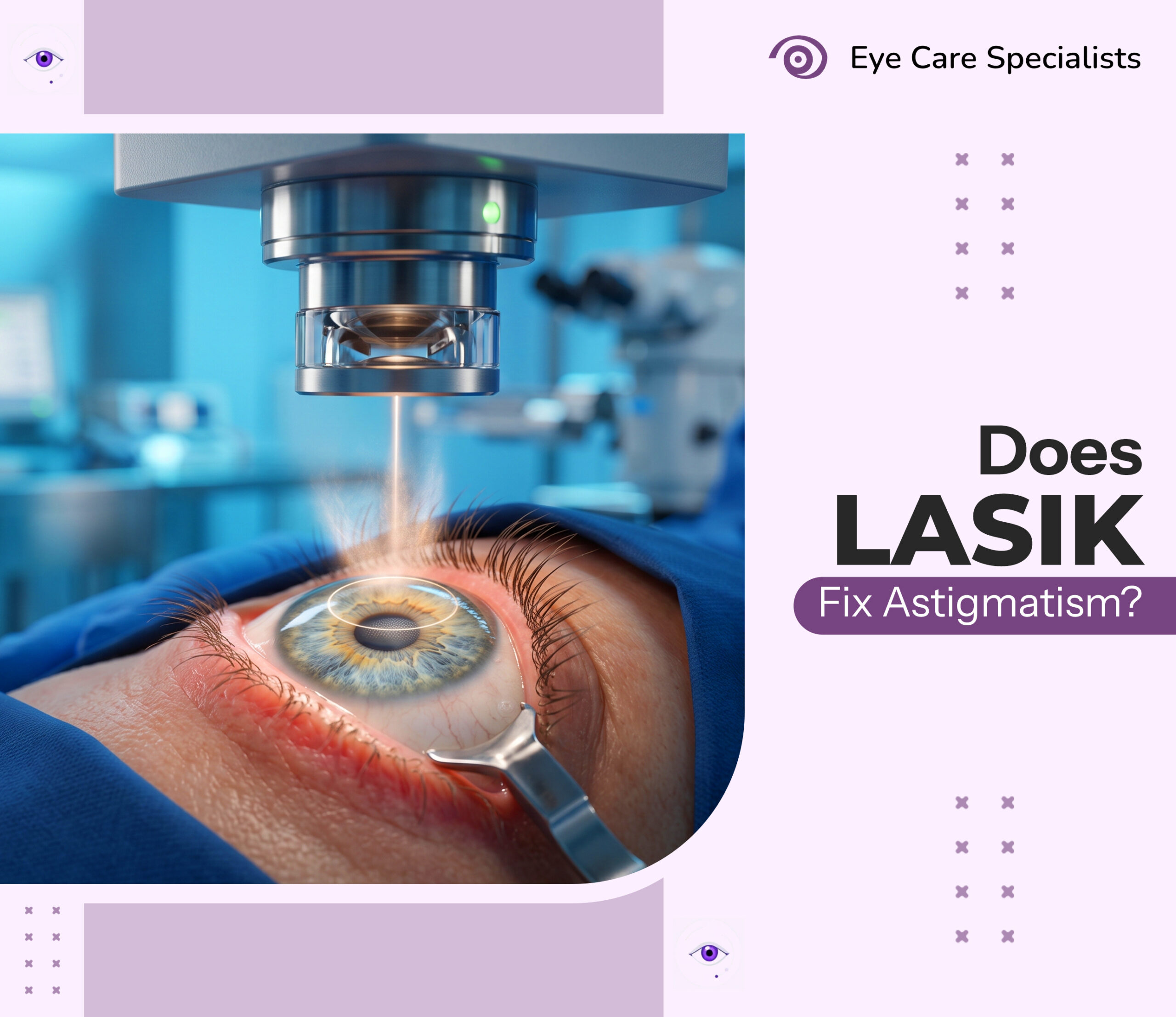
During LASIK, your surgeon performs highly precise laser vision correction:
- First, a femtosecond laser creates a micro-thin corneal flap, which is gently folded back to reveal the inner cornea.
- Next, an excimer laser delivers a customized laser treatment, gently polishing away tissue to perform precise corneal reshaping.
- Finally, the flap is laid back down to heal naturally, allowing light to focus cleanly.
What Is Astigmatism and Why Does It Cause Blurry or Distorted Vision?
Astigmatism is a common refractive error where your eye is shaped more like an oval football than a perfectly round basketball.
Normally, a spherical cornea bends light evenly, focusing it onto a single, clean spot on your retina. With astigmatism, however, an uneven corneal curvature (corneal astigmatism) scatters light in multiple directions at once, creating ghosted or blurry images at all distances.
Astigmatism symptoms also include noticing some lines are sharper than others. The amount of blur depends on the degree of astigmatism and the way light focuses through the eye.
How Does LASIK Reshape the Cornea to Correct Astigmatism?
LASIK corrects astigmatism by selectively reshaping areas of the cornea that have uneven curvature. The goal is to create a more regular corneal shape so light can focus more accurately on the retina.
The treatment follows an individualized digital map to ensure the actual correction matches the exact degree of your visual distortion.
- Measuring Your Specific Curves: Before the procedure begins, advanced diagnostics measure your unique cylinder (the amount of astigmatism) and axis (the specific angle of your eye’s tilt).
- Targeting the Asymmetry: The computerized excimer laser delivers a customized treatment, directing cool light beams only to the specific steep or flat zones of your cornea.
- Smoothing the Surface: By gently polishing away microscopic tissue layers, the laser performs precise corneal reshaping, evening out the oblong shape into a naturally rounded sphere so light focuses cleanly.
What Types and Amounts of Astigmatism Can LASIK Correct?
LASIK can correct several forms of astigmatism, but the amount it can treat depends on the patient’s corneal shape, prescription, and overall eye health.
- Regular astigmatism: LASIK can often correct it by reshaping the cornea so that light focuses more evenly on the retina.
- Irregular astigmatism: LASIK may not be suitable for some cases because the corneal shape varies more significantly. Your eye doctor will need to assess the cornea before recommending treatment.
- Low to moderate astigmatism: LASIK commonly treats low to moderate astigmatism, often up to 4.00 diopters, depending on the laser technology and individual prescription.
- Higher levels of astigmatism: Some patients with higher prescriptions may still qualify, but eligibility depends on factors such as corneal thickness, shape, and prescription stability.
Which Types of Astigmatism Respond Best to LASIK?
LASIK tends to work best for regular astigmatism, where the cornea has a consistent pattern of curvature that the laser can reshape predictably.
- Regular astigmatism: This is generally the best type for LASIK because the two main corneal meridians have a consistent, predictable shape.
- Stable Prescriptions: Prescriptions that have remained unchanged for at least a year can be treated with LASIK.
- Mixed prescriptions: LASIK may correct mixed astigmatism, in which one meridian is nearsighted (myopia), and the other is farsighted (hyperopia). The suitability of treatment depends on the specific prescription and eye measurements.
When Might LASIK Not Be Suitable for Astigmatism?
LASIK works well for many people, but certain eye conditions and prescription limits can make the procedure unsuitable. You may not be a good candidate if you have:
- Irregular astigmatism: An uneven corneal shape caused by conditions such as corneal scarring or keratoconus may not respond safely to standard LASIK.
- Lenticular astigmatism: If the astigmatism comes from the eye’s natural lens rather than the cornea, another type of treatment may be more appropriate.
- High astigmatism: LASIK has treatment limits, and very high prescriptions may fall outside the range that can be corrected safely.
- Thin corneas: LASIK requires enough healthy corneal tissue for safe reshaping. Thin corneas may increase the risk of complications and make another vision-correction option a better choice.
- Fluctuating vision: Your prescription should remain stable before LASIK. If your vision has changed significantly within the past year, your doctor may recommend waiting until it stabilizes.
How Many Diopters of Astigmatism Can LASIK Correct?
LASIK can correct a range of astigmatism prescriptions, but the exact limit varies with your corneal thickness, shape, and overall eye health. A higher prescription does not automatically rule out LASIK, but it requires a careful evaluation.
- Up to 1.00 diopter: Usually within the range LASIK can correct.
- 1.00–3.00 diopters: Commonly treatable when the eyes meet other candidacy requirements.
- 3.00–4.00 diopters: May still be corrected, depending on the laser system and corneal measurements.
- Around 5.00–6.00 diopters: Some advanced LASIK treatments may correct this level, but it approaches the upper end of the treatment range and requires a thorough evaluation.
How Do Doctors Determine Whether You Are a Good LASIK Candidate With Astigmatism?
Determining whether LASIK is right for you takes more than checking your prescription. Your eye doctor will closely examine your cornea, natural lens, tear film, and overall eye health to ensure laser vision correction is both safe and suitable.
Your surgeon may assess the following during your evaluation:
- Mapping your cornea: Corneal topography creates a detailed map of the cornea. It helps your doctor see whether your astigmatism has a regular pattern and rule out conditions such as keratoconus.
- Measuring corneal thickness: LASIK reshapes the cornea, so your surgeon will check whether you have enough healthy corneal tissue for the procedure.
- Checking the source of your astigmatism: Astigmatism can come from the cornea or the eye’s natural lens. Your doctor will determine where the distortion originates because LASIK primarily corrects corneal irregularities.
- Confirming prescription stability: Your astigmatism prescription should remain stable, including its cylinder and axis measurements, before surgery.
- Assessing your tear film: Your doctor will check for dry eye and other tear-film problems that could affect healing and comfort after LASIK.
- Reviewing your overall eye and health history: Your age, medical history, current medications, pregnancy or breastfeeding status, and conditions affecting the eyes can all influence your eligibility.
What Tests Are Performed Before LASIK for Astigmatism?
Before LASIK, your doctor performs a few tests to check your cornea, prescription, and overall eye health.
- Corneal topography: Maps the surface of your cornea to identify the shape and pattern of your astigmatism.
- Corneal thickness test (pachymetry): Measures the thickness of your cornea to make sure it can safely support LASIK.
- Refraction test: Measures your exact prescription, including the degree and axis of your astigmatism.
- Tear film and dry eye testing: Checks whether your eyes produce enough tears for comfortable healing after surgery.
- Eye health examination: Looks for conditions affecting the cornea, natural lens, retina, or other parts of the eye that could affect LASIK results.
What Factors Can Make Someone Ineligible or Require LASIK to Be Delayed?
Certain eye conditions, health changes, or an unstable prescription may mean you need to wait or consider another vision correction option.
- Unstable prescription: If your vision or astigmatism prescription has recently changed, your doctor may recommend waiting until it stabilizes.
- Thin or weak corneas: A cornea that lacks enough healthy tissue may not safely tolerate LASIK reshaping.
- Severe dry eye: Significant dry eye can make recovery more uncomfortable and may need treatment before surgery.
- Certain eye or health conditions: Conditions such as keratoconus, active eye disease, or some autoimmune disorders can make LASIK unsafe.
How Successful Is LASIK for Astigmatism, and Is the Correction Permanent?
LASIK has a high success rate for properly selected patients with astigmatism, with modern treatments often achieving clear vision and a low risk of significant residual prescription.
The correction is long-lasting, but not necessarily permanent. LASIK permanently reshapes the cornea, but your prescription can change later because of natural aging, regression, or other changes in the eye.
What Vision Results Can You Expect After LASIK for Astigmatism?
The vision you get after LASIK depends on your prescription, corneal health, and how your eyes respond during healing. The main goal is to achieve clear distance vision with little or no dependence on glasses.
- 20/20 vision: Some people achieve 20/20 vision or better without glasses after LASIK.
- 20/40 vision or better: Others may reach 20/40 vision, which can still provide clear and useful distance vision for everyday activities.
- Sharper vision: Reshaping the cornea can reduce the blur and visual distortion caused by astigmatism.
- Less reliance on glasses or contacts: Many patients need their corrective lenses less often after LASIK. However, some may still need them for specific activities or if a small prescription remains.
Can Astigmatism Come Back After LASIK?
Yes, astigmatism can return after LASIK, though this does not happen to everyone. LASIK permanently reshapes the cornea, but your prescription can change over time.
Some patients may develop a small amount of residual or recurrent astigmatism as the eye heals or the prescription changes.
Age-related changes and natural shifts in the eye can also affect vision years after surgery. In some cases, an additional procedure may be considered, but only after the prescription and corneal measurements remain stable.
What Is Recovery Like After LASIK for Astigmatism?
Recovery after LASIK for astigmatism is usually quick, although your vision may not feel fully settled right away. You may have some blur, dryness, light sensitivity, glare, or halos during the first few days.
Most early symptoms improve as your eyes heal, but vision can continue to fluctuate for several weeks. For some patients, it can take three to six months for vision to recover fully.
What Are the Alternatives if LASIK Cannot Correct Your Astigmatism?
If LASIK is not a safe or suitable option, you may still have other ways to correct astigmatism. The right choice depends on your prescription, corneal health, and the source of the astigmatism.
| Alternative | How can it help? |
|---|---|
| Glasses | Prescription glasses can correct astigmatism without surgery. |
| Contact lenses | Toric contact lenses can correct regular astigmatism and may provide a wider field of vision than glasses. |
| PRK (Photorefractive Keratectomy) | PRK reshapes the cornea with a laser, but it does not require the corneal flap used in LASIK. |
| Phakic IOLs (Phakic Intraocular Lenses) | An implantable lens sits inside the eye while leaving the natural lens in place and may be an option for certain prescriptions. |
| Toric IOLs (Toric Intraocular Lenses) | For people who need cataract surgery, a toric intraocular lens can help correct astigmatism at the same time. |
Exploring LASIK for Astigmatism with Eye Care Specialists
Does LASIK fix astigmatism? The answer is a resounding yes. The laser surgery permanently reshapes your cornea, letting light enter your retina properly.
As astigmatism affects everyone differently, it’s essential to understand the type and degree of astigmatism. It will help you determine whether you’re eligible for the treatment.
If you’re considering LASIK for fixing your astigmatism, you should consult an ophthalmologist.
At Eye Care Specialists, our team of doctors will evaluate your eyes to finalize the treatment for your eye condition, including astigmatism.
Even if your astigmatism doesn’t qualify for LASIK, we provide PRK (Photorefractive Keratectomy) to reshape the cornea without creating a flap.
Meet our team to find the most appropriate eye surgery for astigmatism today!
FAQs
1. Does LASIK cost more if you have astigmatism?
No, not necessarily. LASIK pricing usually depends on factors such as the technology used, your prescription, and the clinic. Having astigmatism alone does not automatically mean a higher cost. However, some advanced treatments may cost more if they require specialized laser technology.
2. Is LASIK for astigmatism covered by health or vision insurance?
Usually, no. Most health and vision insurance plans consider LASIK an elective procedure and do not cover its full cost. Some plans may offer discounts or other benefits. Check your insurance policy or ask your LASIK provider about available coverage and payment options.
3. Do I need to stop wearing toric contact lenses before my LASIK consultation?
Yes, you may need to. Toric contact lenses can temporarily alter the shape of your cornea and affect the accuracy of eye measurements. Your doctor will tell you how long to stop wearing them before your evaluation. The required time can vary depending on your lens type.
4. Will LASIK eliminate the cylinder and axis numbers from my eyeglass prescription?
It can, but not always completely. LASIK aims to correct the corneal curvature responsible for astigmatism, which can reduce or eliminate the cylinder and axis values in your prescription. Some patients may still have a small amount of residual astigmatism after surgery.
5. Can LASIK treat different amounts of astigmatism in each eye?
Yes, LASIK treatment can be customized for each eye based on its individual prescription and corneal measurements. One eye may have more astigmatism than the other. Your surgeon will determine whether both eyes fall within a safe and appropriate treatment range.
6. Will I still need reading glasses after LASIK corrects my astigmatism?
Yes, you may. LASIK corrects refractive errors such as astigmatism, but it does not prevent presbyopia, the natural loss of near vision that comes with age. As presbyopia develops, you may still need reading glasses even if LASIK successfully corrects your distance vision.
7. Can LASIK improve vision if I have both astigmatism and amblyopia (lazy eye)?
Yes, it may improve your vision, but it cannot treat amblyopia itself. LASIK can correct the astigmatism that contributes to blurred vision. However, amblyopia develops from reduced visual development in the brain, so the amount of improvement depends on the severity of the condition.
8. Can LASIK accidentally create or worsen astigmatism?
Yes, it can, although this is not the expected result. Changes in corneal shape after LASIK can sometimes leave residual astigmatism or cause it to develop. Careful screening, accurate measurements, and appropriate treatment planning help reduce this risk.
9. Can a LASIK enhancement correct small amounts of astigmatism left after the first procedure?
Yes, in some cases. An enhancement may correct residual astigmatism once the prescription has stabilized and the cornea has sufficient healthy tissue for further treatment. Your surgeon will first take detailed measurements to determine whether an enhancement is safe and appropriate.
10. Can eye exercises or natural treatments reduce astigmatism enough to avoid LASIK?
No. Eye exercises, vitamins, or natural remedies cannot reshape the cornea enough to correct astigmatism. Glasses and contact lenses can improve vision without surgery. Your eye doctor can also discuss other vision-correction options if LASIK is not right for you.