Thinking about PRK surgery but wondering if the longer recovery is worth it compared with LASIK? You are not alone.
Photorefractive Keratectomy (PRK) is a highly reliable, time-tested laser vision correction option that corrects common refractive errors like nearsightedness (myopia), farsightedness (hyperopia), and astigmatism.
Unlike LASIK, PRK achieves precise corneal reshaping without creating a permanent flap in your eye.
This surface-level approach eliminates flap-related complications, making it an exceptionally safe alternative for patients with active lifestyles, dry eyes, or naturally thin corneas.
While you can expect some initial blurry vision and a more gradual PRK recovery as your delicate surface cells heal, the long-term visual outcomes of both procedures are virtually identical.
This blog covers the PRK procedure, what to expect during recovery, and when your vision may stabilize. It also explains the potential risks and side effects and compares PRK with LASIK to help you understand the key differences.
What Is PRK Surgery and Who May Be a Good Candidate?
PRK (Photorefractive Keratectomy) is a straightforward laser procedure that corrects your vision by gently reshaping the surface of your eye. Because it does not require a surgical flap like LASIK, it is a highly reliable option if your eye structure or daily activities require a flap-free approach.
You may be an ideal candidate for PRK if you have:
- Thinner corneas: If your corneal tissue is too thin for a safe LASIK flap, PRK corrects your vision without compromising your eye’s natural strength.
- An active lifestyle: Athletes, first responders, and military personnel choose PRK because there is no risk of surgical flap displacement from physical impact.
- Dry eye tendencies: Since PRK avoids cutting deeper corneal nerves, it is generally much gentler if you already struggle with dry eyes.
- A stable prescription: Your vision must have remained unchanged for at least 1 full year to ensure lasting, predictable results.
- Healthy eyes and body: You must be at least 18, free from active infections, and have no health conditions that slow down your body’s natural healing.
- Past eye surgeries: If you need a quick touch-up to fine-tune your vision after a previous cataract or LASIK procedure, PRK is often the safest option.
What Vision Problems Can PRK Correct?
PRK can correct several common refractive errors by reshaping the cornea and helping light focus properly on the retina. The procedure may be used to treat:
- Myopia (nearsightedness): Distant objects look blurry because light focuses in front of the retina instead of directly on it.
- Hyperopia (farsightedness): Nearby objects may look blurry because light focuses behind the retina.
- Astigmatism: An unevenly curved cornea can lead to blurry or distorted vision, whether you’re looking at something close up or far away.
Who Is Typically Considered a Good Candidate for PRK?
A good PRK candidate needs more than a suitable prescription for glasses. An ophthalmologist will also look at corneal health, prescription stability, overall eye health, and whether PRK fits the person’s lifestyle and expectations.
- Thin or irregular corneas: PRK treats the corneal surface without creating a LASIK flap, which may make it suitable for some people with thinner or more irregular corneas.
- An active lifestyle or high-impact job: Athletes, first responders, and military personnel may prefer PRK because an eye injury could displace no flap.
- Dry eye concerns: PRK may be an option for some people with dry eyes, though your surgeon will first assess your tear film and overall eye health.
- A stable prescription: Your vision prescription should remain stable, often for at least one year, before undergoing laser vision correction.
- Good overall eye health: Candidates are generally at least 18 and should not have active eye infections or corneal conditions that could interfere with epithelial healing.
How Is PRK Surgery Performed?
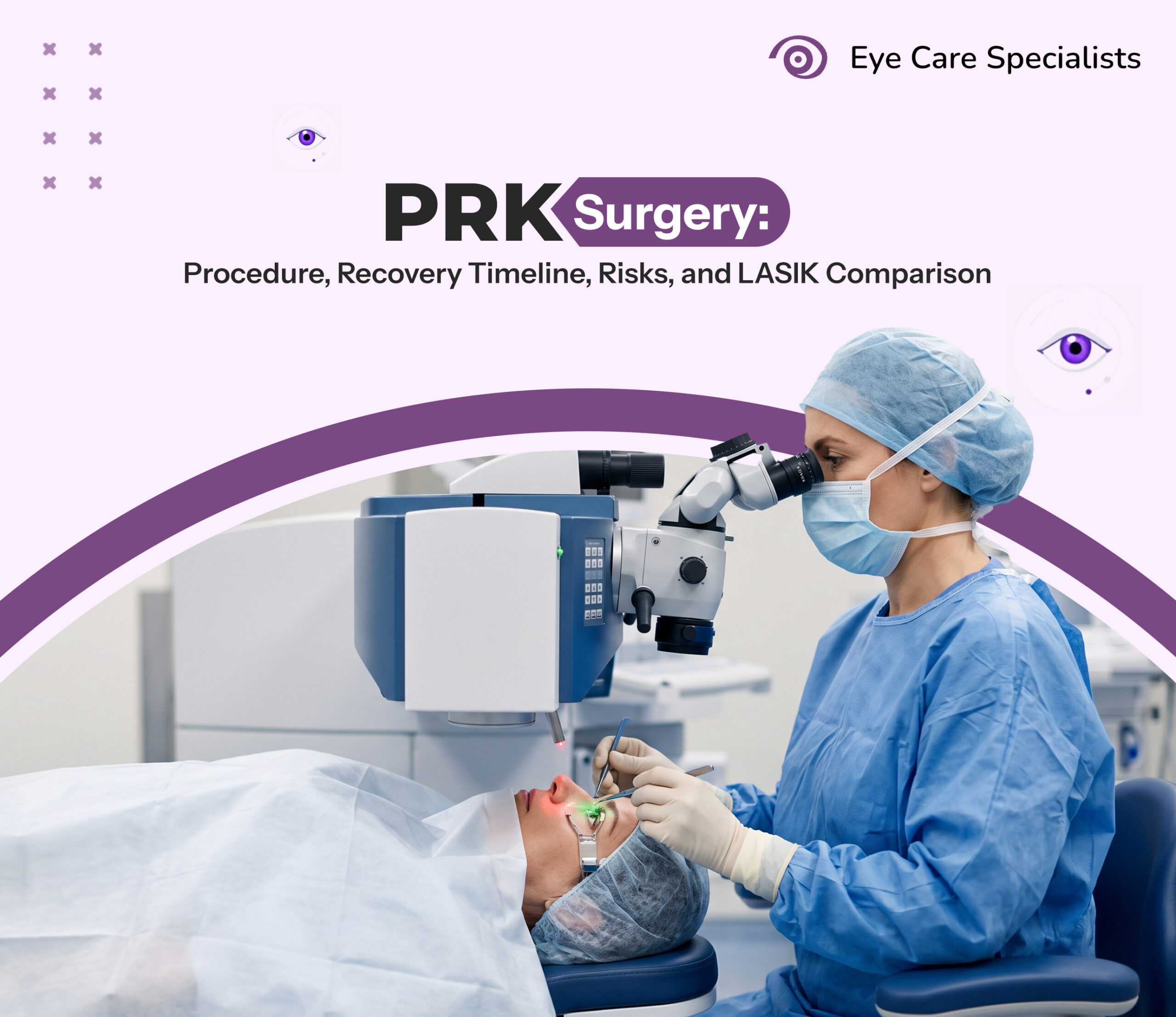
PRK begins with numbing the eye and gently removing the thin outer layer of the cornea, called the epithelium. An excimer laser then reshapes the underlying corneal tissue to correct the patient’s refractive error.
Once the treatment is complete, the surgeon places a bandage contact lens over the eye to protect the surface while it heals. The epithelium gradually grows back over the treated area, allowing the eye to recover and vision to improve.
How Do You Prepare for PRK Surgery?
A little preparation can make the PRK surgery procedure and early recovery easier. Your surgeon will give you specific instructions, but the usual steps include:
- Stop wearing contact lenses: You may need to switch to glasses for a period before your eye measurements and surgery. The timing depends on the type of lenses you wear.
- Follow your medication instructions: Tell your surgeon about any medicines or eye drops you use. Follow their advice about what to continue or stop before surgery.
- Avoid eye makeup: Skip makeup, creams, and lotions around your eyes on the day of surgery to reduce the risk of irritation or infection.
- Keep your eyes clean: Your surgeon may recommend specific cleaning instructions before surgery.
What Happens During PRK Step by Step?
PRK surgery is usually quick and performed while you are awake. After numbing your eyes, your surgeon removes the outer layer of the cornea and uses a laser to reshape the underlying tissue.
The following steps take place during PRK:
Step 1: Numbing the eye
Your surgeon applies numbing eye drops to keep you comfortable throughout the procedure.
Step 2: Removing the epithelium
The thin outer layer of the cornea is gently removed to expose the treatment area.
Step 3: Corneal reshaping
An excimer laser removes tiny, precisely measured amounts of corneal tissue to correct your refractive error.
Step 4: Eye protection
A soft bandage contact lens is placed over the treated cornea to protect it while the surface begins to heal.
Does PRK Surgery Hurt?
Usually, no. The procedure itself is generally painless because numbing eye drops keep the eyes comfortable during treatment.
You may notice some pressure or mild discomfort while the surgeon works, but sharp pain is not expected. Discomfort usually becomes more noticeable after the procedure as the corneal surface heals, especially during the first few days.
What Is the PRK Recovery Timeline?
PRK recovery happens gradually because the corneal surface needs time to heal after surgery. Your PRK recovery time can vary, but most patients see steady improvement as epithelial healing progresses.
| Recovery Stage | What Is Happening? | What Patients May Notice? |
|---|---|---|
| Day 1 | The epithelium begins to heal, while the bandage contact lens protects the cornea. | Blurry vision, light sensitivity, tearing, and discomfort are common. |
| Days 2–3 | Epithelial healing continues, but the corneal surface remains sensitive. | Discomfort may be at its strongest. Vision can remain blurry, and bright light may feel uncomfortable. |
| Days 4–5 | The surface layer continues to close and repair itself. The bandage lens may be removed once healing is sufficient. | Discomfort usually starts to ease, but fluctuating vision and blurry vision can continue. |
| Week 1–2 | The cornea continues healing after the surface has closed. | Vision gradually improves, although it may still change from day to day. |
| Weeks 3–6 | Deeper corneal healing continues, and visual recovery becomes more noticeable. | Most patients see clearer vision, but some may still experience dryness, glare, or fluctuating vision. |
| Months 1–3 | The cornea continues to settle as healing progresses. | Vision generally becomes more consistent, though minor changes can still occur. |
What Should You Expect During the First 5 Days After PRK?
The first five days are usually the most uncomfortable part of PRK surgery recovery. Your eyes are healing during this time, so blurry vision, light sensitivity, and discomfort are common.
- Day 1: Vision is usually blurry, and your eyes may feel irritated or watery. Light sensitivity is also common.
- Days 2-3: Discomfort often peaks as the corneal surface continues to heal. You may notice significant blurry vision, sensitivity to light, and increased tearing.
- Days 4-5: The discomfort usually starts to improve as the surface heals. Vision may still be hazy or fluctuating, so don’t expect clear, stable sight yet.
- Follow your eye-drop schedule: Use prescribed drops exactly as directed to support healing and protect against complications.
- Protect your eyes: Avoid rubbing them and follow your surgeon’s instructions regarding screen use, water exposure, makeup, and outdoor activities.
- Attend your follow-up appointment: Your surgeon will assess how the corneal surface is healing and decide when the protective contact lens can be removed.
When Can You Return to Work, Driving and Normal Activities After PRK?
Most patients safely resume driving, work, and light activities within 5-7 days of their procedure. The PRK surgery recovery time typically aligns with the removal of your protective bandage contact lens once the delicate surface cells have healed.
While you can manage basic household tasks sooner, waiting until your vision stabilizes ensures you remain completely safe on the road and comfortable at work.
When Does Vision Fully Stabilize After PRK?
Most people reach stable vision within 3-6 months after PRK, although it can take longer for some. Vision usually becomes clearer over the first few weeks, but some fluctuations are normal while the cornea continues to heal.
Your surgeon will track your visual recovery at follow-up visits and confirm when your vision has fully stabilized.
What Are the Risks, Side Effects and Possible Complications of PRK?
PRK is generally considered a safe and effective form of laser vision correction, but like any surgery, it carries some risks. Most people experience temporary changes during PRK recovery, while more serious complications are less common.
What Side Effects Are Common During PRK Recovery?
While the vast majority of patients heal smoothly, it is completely normal to experience some temporary visual changes and mild discomfort during PRK recovery.
The following are the common side effects you can experience:
- Gritty or scratchy sensation: Mild watering and irritation are normal for the first few days, often feeling like a stubborn speck of dust is caught in your eye.
- Sensitivity to light: Bright lights and sunshine can feel quite intense early on, so keeping a pair of UV-blocking sunglasses handy is essential for your comfort.
- Fluctuating or hazy vision: Your sight will naturally drift between clear and blurry as the surface cells heal, steadily settling into a sharp, reliable focus.
- Temporary dry eyes: Your eyes may produce fewer natural tears for a few months, but regular use of lubricating drops helps keep them comfortable.
- Nighttime glare and halos: You might temporarily see soft rings or starbursts around headlights, but these will steadily fade as the eye’s surface smooths out.
What Less Common PRK Complications Should Patients Know About?
Serious complications with PRK are highly unusual. However, understanding the less common risks associated with deeper corneal healing helps you make a fully informed decision about your care.
- Corneal haze: This temporary, mild clouding can develop during the deep healing phase but is easily cleared up with prescribed steroid drops.
- Under- or overcorrection: Because every eye heals uniquely, your vision might slightly miss the target. If needed, a quick touch-up can fine-tune your focus.
- Delayed surface healing: On rare occasions, the delicate outer cells on your eye’s surface may take a few extra days to close completely.
- Post-operative infection: To protect against this very rare risk, we prescribe prophylactic antibiotic drops and closely monitor your healing.
- Refractive regression: Years down the road, your eye could shift slightly toward your old prescription, which is easily corrected with a simple touch-up.
How Does PRK Compare With LASIK?
PRK and LASIK both use laser treatment to correct refractive errors. The main difference is how they access the cornea. PRK removes the outer epithelial layer, while LASIK creates a thin corneal flap before reshaping the underlying tissue.
The key differences include:
| Feature | PRK | LASIK |
|---|---|---|
| Surgical technique | Removes the outer epithelial layer. No corneal flap is created. | Creates a thin corneal flap before reshaping the underlying tissue. |
| Early healing | The epithelium grows back over several days under a protective contact lens. | The corneal flap is repositioned and begins healing quickly. |
| Visual recovery | Vision improves gradually over the first few weeks and may fluctuate during healing. | Vision usually improves much faster, often within the first few days. |
| Candidacy | May suit people with thinner corneas or those at higher risk of eye trauma. | Often preferred when the cornea is suitable and a faster recovery is important. |
| Flap-related risks | No flap means there is no risk of flap displacement. | A rare risk of flap-related complications remains. |
What Results Can You Expect After PRK Surgery?
PRK is an effective form of refractive surgery that can significantly improve vision and reduce your need for glasses or contact lenses.
Results develop gradually as the cornea heals, so the outcome may take several months to settle.
- Clearer vision: Most patients experience a meaningful improvement in vision after the initial healing period.
- Less dependence on glasses or contacts: Many people can manage most daily activities without corrective lenses after PRK.
- Correction of refractive errors: PRK can correct myopia, hyperopia, and astigmatism in suitable candidates.
- Gradual visual improvement: Vision may remain blurry or fluctuate during the early weeks before becoming more consistent.
- Long-term results: Once the cornea has fully healed and vision stabilizes, the correction is generally long-lasting. However, PRK does not prevent age-related changes such as presbyopia or cataracts.
Understand Your PRK Journey with Eye Care Specialists
PRK is a flap-free approach that eliminates the risk of flap-related injuries. However, choosing to undergo this surgery is a highly personal choice.
Once your ophthalmologist analyzes your unique corneal anatomy, lifestyle, and recovery preferences, they suggest whether PRK is the right treatment plan for you.
At Eye Care Specialists, we conduct a comprehensive eye exam to understand your vision needs. Based on the test results, we recommend PRK or another type of refractive surgery.
Learn about your vision correction choices with our experts.
FAQs
1. Can PRK Be Performed After Previous LASIK Surgery?
Yes, in some cases. PRK may be used as an enhancement after LASIK if you develop a significant residual or recurring refractive error. Your surgeon will first assess your corneal thickness, shape, previous LASIK treatment, and overall eye health to determine whether another procedure is appropriate.
2. Can You Have PRK After Cataract Surgery?
Yes, PRK may help correct a remaining refractive error after cataract surgery when glasses-free vision was not fully achieved. However, your prescription should be stable, and your eyes must be healthy enough for laser treatment. Your ophthalmologist will assess whether PRK is suitable.
3. Can PRK Surgery Be Done More Than Once?
Yes, a second PRK procedure may be considered if some refractive error remains or your prescription changes after the first treatment. Your vision should be stable before considering an enhancement, and your surgeon will first assess your corneal health and remaining tissue.
4. What Is Trans PRK and How Is It Different From Traditional PRK?
Trans PRK is a surface-based laser procedure that uses a laser to remove the corneal epithelium rather than removing it manually or with an instrument. Traditional PRK typically removes this outer layer first, followed by laser reshaping of the underlying corneal tissue.
5. What Is the Difference Between PRK, LASEK and Epi-LASIK?
PRK, LASEK, and Epi-LASIK all reshape the cornea without creating a conventional LASIK flap. The main difference lies in how the epithelium is handled before laser treatment. Your surgeon will choose the approach based on your corneal anatomy, prescription, eye health, and treatment needs.
6. Can You Wear Contact Lenses Again After PRK If You Still Need Vision Correction?
Yes, you may be able to wear contact lenses after PRK once your eyes have fully healed and your surgeon confirms they are safe to wear. Your prescription and corneal surface may change during recovery, so wait until your vision has stabilized before being fitted for lenses.
7. How Much Does PRK Surgery Typically Cost?
PRK surgery costs between $1,500 and $5,500. The range usually varies based on the surgeon, technology used, location, and what the treatment package includes. Because clinics set their own fees, there is no single standard price. Ask your eye care provider for a personalized estimate after your evaluation and discuss what the fee covers.
8. Is PRK Surgery Usually Covered by Health or Vision Insurance?
Usually, no. PRK is generally considered an elective refractive procedure rather than medically necessary treatment, so many health and vision plans do not cover it. However, benefits vary between insurance providers. Check your specific plan to see whether it offers any discounts or benefits for refractive surgery.
9. Can PRK Be Performed on Only One Eye?
Yes. PRK can be performed on one eye when only that eye requires correction or when treating both eyes simultaneously is not appropriate. Your surgeon will consider the prescription, corneal health, visual needs, and overall balance between your two eyes.
10. Can One Eye Have PRK While the Other Eye Has LASIK?
Yes, in certain situations. A surgeon may recommend PRK for one eye and LASIK for the other when the eyes have different corneal characteristics or treatment needs. The decision depends on your individual anatomy, prescription, lifestyle, and suitability for each type of laser vision correction.