Are you experiencing blurry or distorted vision? You may have astigmatism.
It is a common eye disorder that develops when the cornea or lens is irregularly shaped. Because of that, the light doesn’t focus evenly on the retina, making the objects appear less sharp than they should.
Being a common refractive error, astigmatism can make your vision fuzzy at both near and far distances. The symptoms are not always obvious.
Some people experience only mild changes in their vision, while others notice problems during everyday activities such as reading, using digital screens, driving at night, or looking at bright lights.
Since these astigmatism symptoms can develop gradually, they are often mistaken for eye fatigue or the need for a new glasses prescription.
Understanding the signs of astigmatism is the first step toward protecting your vision.
In this blog, you’ll learn about the most common symptoms, what causes astigmatism, how it affects the eye, and the available treatment options. You will also learn whether astigmatism can worsen over time, and how to tell it apart from other eye conditions.
What Is Astigmatism and How Does It Affect the Eye?
Astigmatism is a common refractive error that occurs when the cornea or the eye’s natural lens is not perfectly round. Instead of having a smooth, spherical shape, it has an uneven curve.
The condition prevents light from focusing on a single point on the retina, the light-sensitive tissue at the back of the eye. Hence, vision appears blurred or distorted. Astigmatism can occur on its own or along with vision imbalances. An individual can acquire it at birth, or it can develop over time due to natural changes in the eye.
How Does an Irregular Cornea or Lens Distort Vision?
A healthy cornea and lens bend light evenly. It thus converges light at a single point on the retina.
With astigmatism, the cornea or lens has an uneven curve, causing light to focus at multiple points instead of one. As a result, the image reaching the retina is not sharp.
What Are the Different Types of Astigmatism?
Astigmatism can be categorized according to the part of the eye that is irregularly shaped. The eye disorder also depends on how the light focuses within the eye.
- Corneal astigmatism: A common refractive error that occurs when the cornea has an uneven shape.
- Lenticular astigmatism: Develops when the eye’s natural lens has an irregular shape, even if the cornea is normal.
- Regular astigmatism: The principal curves of the cornea are at 90-degree angles to each other. It is a common astigmatism and can usually be corrected with glasses, refractive surgery options, or toric contact lenses.
- Irregular astigmatism: It is a type of astigmatism where the corneal curves are not perpendicular. It is a less common condition caused by corneal injury, scarring, or keratoconus.
- Myopic astigmatism: A single focal line falls in front of the retina, blurring out subjects that are at a distance.
- Hyperopic astigmatism: Both focal lines fall behind the retina, making close objects appear distorted.
- Mixed astigmatism: Two focal lines exist, one at the front of the retina and the other behind it. The condition causes blurred vision at all distances.
What Are the Most Common Symptoms of Astigmatism?
Astigmatism affects everyone differently and often depends on how severe the condition is. Mild astigmatism may not cause noticeable problems, while moderate or severe astigmatism can affect everyday activities.
The most common signs include:
- Fuzzy or distorted vision at both near and far distances.
- Frequent headaches, especially after reading or prolonged screen use.
- Squinting to see clearly, as your eyes try to improve focus.
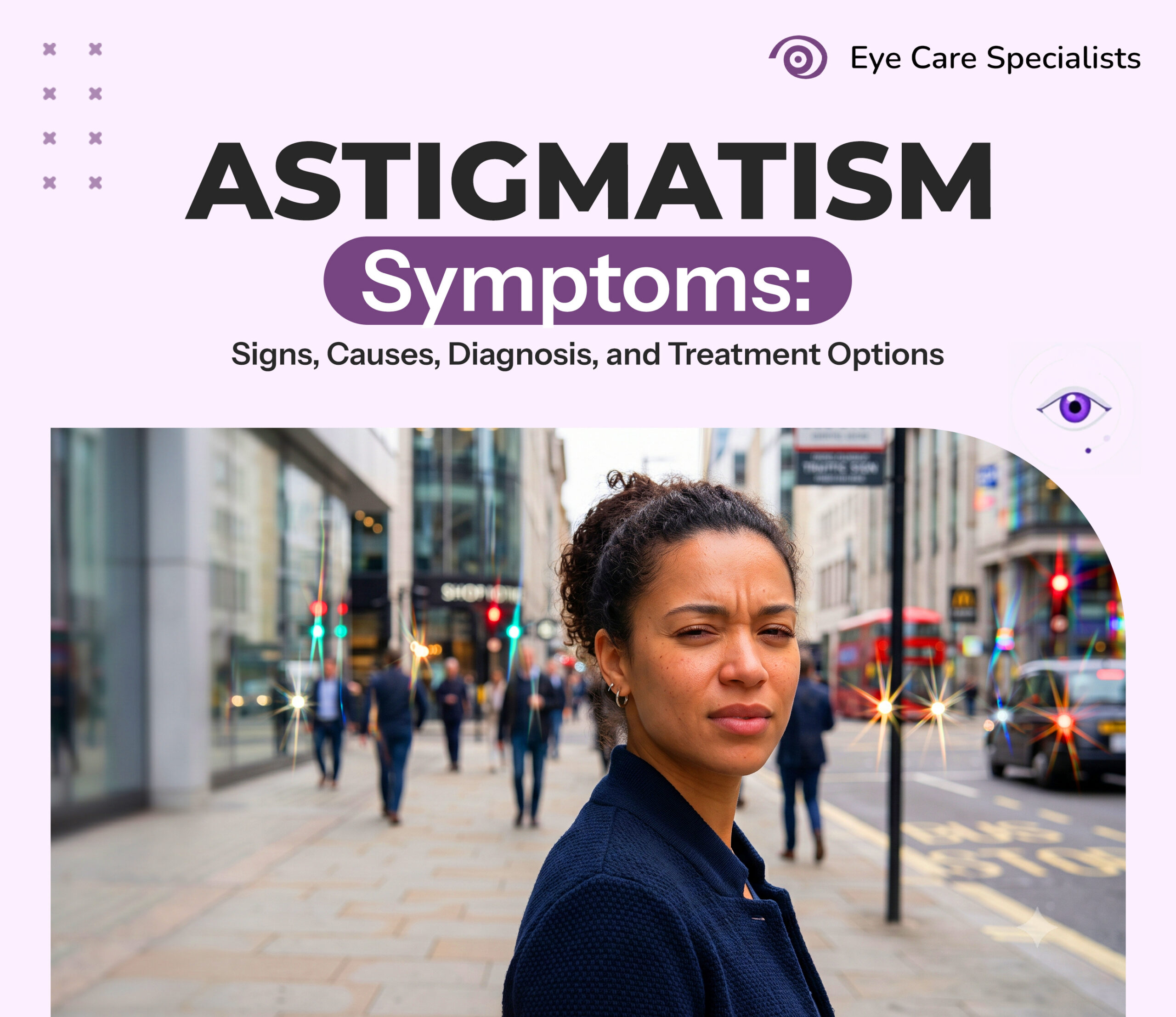
- Poor night vision, including glare, halos, or starbursts around lights that can make driving after dark more difficult.
- Eye discomfort for long periods, particularly during tasks that require sustained visual attention.
Why Does Astigmatism Cause Blurry or Distorted Vision?
Astigmatism causes blurry or distorted vision because the cornea or lens has an uneven curve. The irregular shape prevents light from focusing at a single point on the retina. Instead, the eye focuses it at multiple points.
It creates a blockage in images from appearing sharp. As a result, objects may look blurred, stretched, or slightly distorted whether they are close or far away. The amount of blur depends on the degree of astigmatism.
Why Can Astigmatism Cause Headaches, Eye Strain, or Tired Eyes?
Astigmatism can cause headaches, eye strain, and tired eyes because the unevenly shaped cornea forces eye muscles to bring objects into focus. The extra effort becomes more noticeable during activities that require sustained focus, such as reading, using a computer, or looking at a phone for long periods.
According to the National Library of Medicine, prescribed glasses or contact lenses help relieve these symptoms by correcting the focusing error.
Why Do People With Astigmatism Squint More Often?
People with astigmatism squint more because narrowing the eyelids reduces the amount of scattered light entering the eye. It temporarily improves focus and makes objects appear a little sharper.
However, squinting does not correct the underlying refractive error. It is only a short-term response to blurred vision.
Why Is Night Driving Harder With Astigmatism?
It is common to face difficulty driving at night with astigmatism. In dim light, your pupils become larger to let in more light. It can make the uneven focusing caused by astigmatism more noticeable.
As a result, it becomes difficult to see road signs, lane markings, and pedestrians clearly. Bright headlights and streetlights may also create halos, starbursts, or glare around headlights.
These visual effects can reduce contrast and make driving after dark more challenging. Proper vision correction can often improve night-time visual clarity.
What Causes Astigmatism?
Astigmatism occurs when the cornea or the eye’s natural lens is irregularly shaped. In most cases, ophthalmologists cannot identify a single cause.
While some individuals are born with astigmatism, others may acquire it later in life as the eye changes.
The following are the common causes of astigmatism:
- A naturally irregular cornea or lens.
- Genetics, as astigmatism often runs in families.
- Normal eye development, indicating people were born with the condition.
- Eye injuries or corneal scarring that change the cornea shape.
- Previous eye surgery, if it alters the curvature of the cornea.
- Keratoconus, a condition that makes the cornea thinner and protrude outward into a cone-like shape.
Can Reading in Low Light or Sitting Too Close to a Screen Cause Astigmatism?
No, reading in low light or sitting too close to a screen does not cause astigmatism. It is rather an effect of astigmatism.
When your cornea or natural lens is irregularly shaped, the light doesn’t focus on the retina properly. It therefore blurs your vision and makes things appear hazy at both distances.
To see objects clearly, especially in low light or when you sit in front of the screen, you put pressure on the eye muscles. It leads to headaches or tired eyes.
What Tests Are Used to Check for Astigmatism?
An ophthalmologist can diagnose astigmatism through a comprehensive eye examination. The test is designed to assess your vision, the shape of your cornea, and the way light is focused on your retina.
Research published in the National Library of Medicine shows that comprehensive eye examinations help accurately detect astigmatism and determine the correct prescription for clearer vision.
- Visual Acuity Test: Measures how clearly you can see letters or symbols at various distances.
- Refraction Test: Looking through a device called a phoropter at a series of lenses to determine the precise prescription that makes your vision clear.
- Keratometry: Measures the curvature of the cornea using a beam of light on your eye to detect irregularities associated with astigmatism.
- Corneal Topography: Creates a detailed map of the cornea using a specialized computer scan to identify uneven shape.
- Retinoscopy: Shining light into the pupil to evaluate how light reflects from the retina while different lenses are placed in front of the eye.
What Are the Best Treatment Options for Astigmatism?
The best treatment options for astigmatism depend on its severity and your eye health. If you have an oval-shaped eye that is affecting the light focusing on the retina, your ophthalmologist will recommend a treatment after an eye exam.
The common treatments for astigmatism are:
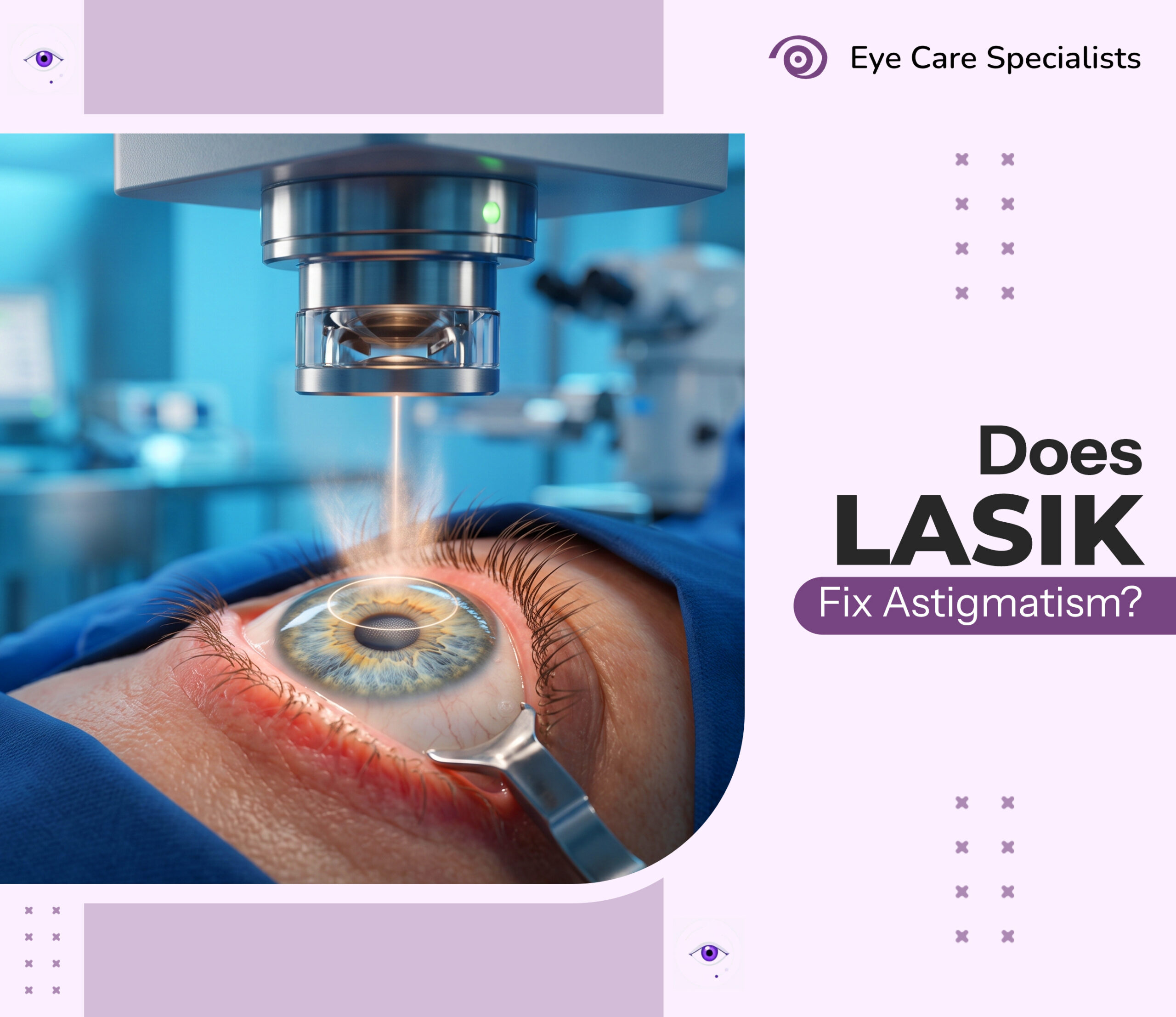
- LASIK (laser-assisted in situ keratomileusis): Reshapes the cornea by creating a flap in the front that allows light to enter the retina.
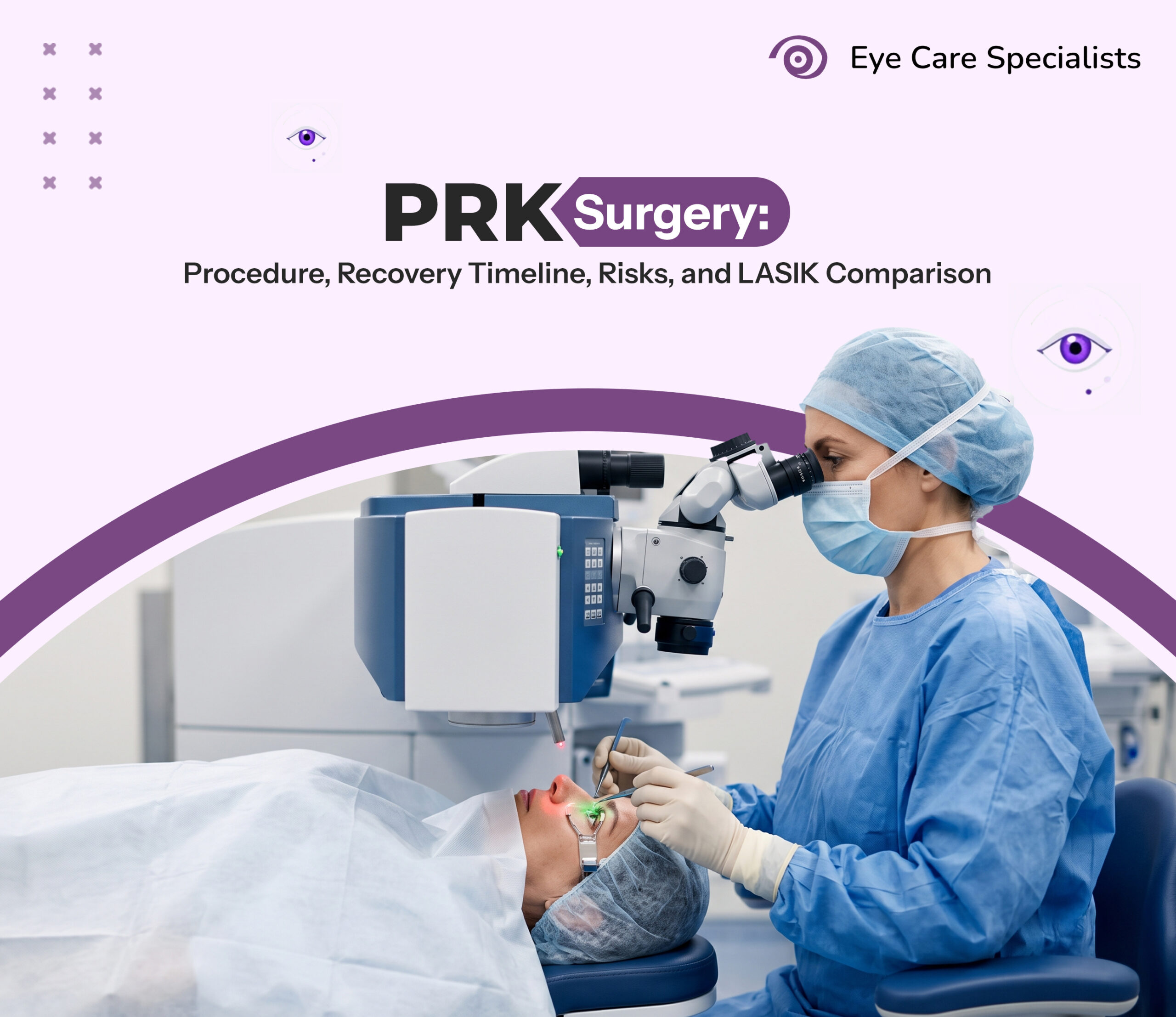
- PRK (Photorefractive Keratectomy): A laser vision correction procedure that reshapes the cornea without creating a corneal flap. It may be recommended for some patients.
- Toric Intraocular Lens (IOL): A specialized artificial lens implanted as a replacement for the cloudy natural lens during a cataract surgery procedure to correct both cataracts and astigmatism at the same time.
- Toric Implantable Collamer Lens (ICL): A lens implanted behind the iris and in front of the natural lens to correct moderate to high astigmatism.
- Eyeglasses: Equipped with special cylindrical lenses that correct the way light bends into your retina.
Can Astigmatism Get Worse Over Time?
Yes, astigmatism can worsen over time due to the natural aging of the eye, keratoconus, or an eye injury. All these changes shift the structure of the eye, even leading to a football-shaped cornea that obstructs light from entering the retina properly.
As the condition progresses, blurred vision may become more noticeable, and activities such as reading or driving may become more difficult.
How Can You Tell Whether Your Symptoms Are Astigmatism or Another Eye Problem?
Blurred vision, eye strain, or headaches don’t always mean you have astigmatism. These symptoms could also occur with:
- Cataracts: Clouding of the natural lens, causing painless blurry vision.
- Nearsightedness: Making close objects sharper but distant objects hazy.
- Farsightedness: When distant objects are clearer, and nearby objects are out of focus.
If you have astigmatism, your vision will be blurry at all distances. Moreover, you would find it difficult to drive at night because you would experience halos around lights. Most importantly, your ophthalmologist will conduct an eye exam and confirm your astigmatism.
What Should You Do Next If You Think You Have Astigmatism?
After experiencing blurred vision at all distances or seeing light streaks in low light, if you think you have astigmatism, then you should visit your ophthalmologist.
They would diagnose your eye with proper tests to identify the cause of your vision changes and determine whether astigmatism or another eye condition is responsible.
If you need treatment, your ophthalmologist will recommend the most appropriate option based on the eye examination. Avoid self-diagnosing or relying on over-the-counter glasses, as an accurate prescription is essential for clear, comfortable vision.
Understand Your Astigmatism Treatment Options With Eye Care Specialists
Living with untreated astigmatism symptoms can make everyday activities like reading, using digital devices, and driving more challenging. The good news is that astigmatism can be accurately diagnosed and effectively managed with the right treatment.
At Eye Care Specialists, our experienced ophthalmologists perform comprehensive eye examinations to determine the cause of your vision changes and recommend personalized treatment options.
From cataract surgery to PRK (Photorefractive Keratectomy) surgery, each of our treatments helps correct refractive errors.
Start your journey toward a clearer vision with our expert guidance today!
Astigmatism Symptoms: FAQs
Can astigmatism affect only one eye?
Yes, it is possible to have astigmatism only in one eye. The condition is called unilateral astigmatism, where the cornea or lens of only one eye is unevenly shaped. If you experience blurred vision only in one eye at different distances, it could mean you have astigmatism.
Can mild astigmatism go unnoticed?
Yes, mild astigmatism often goes unnoticed. Many people discover uneven curvature of the eye during a routine eye examination. But if the error doesn’t affect your daily life significantly, prescription glasses can be helpful.
Does astigmatism make lights look stretched or streaky?
Yes, astigmatism can cause lights to appear stretched or streaky, particularly at night. It happens because the cornea or the lens inside is in an oval or football shape, blocking the light from falling evenly on the retina.
Can astigmatism cause problems with reading?
Yes, astigmatism can make letters appear blurred or slightly distorted, making reading more tiring. Many people also experience eye strain or headaches after focusing on books, phones, or computer screens for long periods.
Is astigmatism the same as lazy eye?
No, astigmatism is not the same as lazy eye. It is a refractive error that occurs due to an unevenly curved cornea or lens. Lazy eye, also called amblyopia, is a condition in which one eye does not develop normal vision during childhood.
Can astigmatism come back after LASIK?
Yes, even after LASIK, astigmatism can come back. It is a laser procedure that permanently reshapes the cornea to correct your blurry vision. However, as you age and your eye loses flexibility, you can squint while reading, indicating the return of astigmatism. If it happens, your ophthalmologist will evaluate whether additional treatment or updated vision correction is appropriate.
Are regular contact lenses enough for astigmatism?
Regular contact lenses can help with astigmatism, depending on the severity. If you have very mild astigmatism, you may achieve good vision with standard soft contact lenses. However, moderate or higher amounts require specialized lenses to correct the eye’s uneven curvature.
Can dry eyes make astigmatism symptoms feel worse?
Yes, dry eyes can make astigmatism symptoms feel worse by disrupting the tear film. It can temporarily blur vision and increase eye discomfort, making existing astigmatism feel worse. Treating dry eyes may improve visual comfort, but it will not correct the refractive error.
Is astigmatism common in children?
Yes, astigmatism is common in children and is often present from birth. Many children have mild astigmatism that does not affect daily activities. Regular pediatric eye examinations are crucial because significant astigmatism can interfere with normal visual development if left uncorrected.
Can cataract surgery correct astigmatism?
Yes, cataract surgery can correct astigmatism by implanting a toric intraocular lens (IOL) or by making precise corneal incisions during the procedure. Your ophthalmologist will recommend the most appropriate approach based on the amount of astigmatism and your overall eye health.