Have you witnessed 20/20 listed on an eye chart? It is the standard for clear vision, but your score can go beyond that mark to 20/15 vision. But what is 20/15 vision?
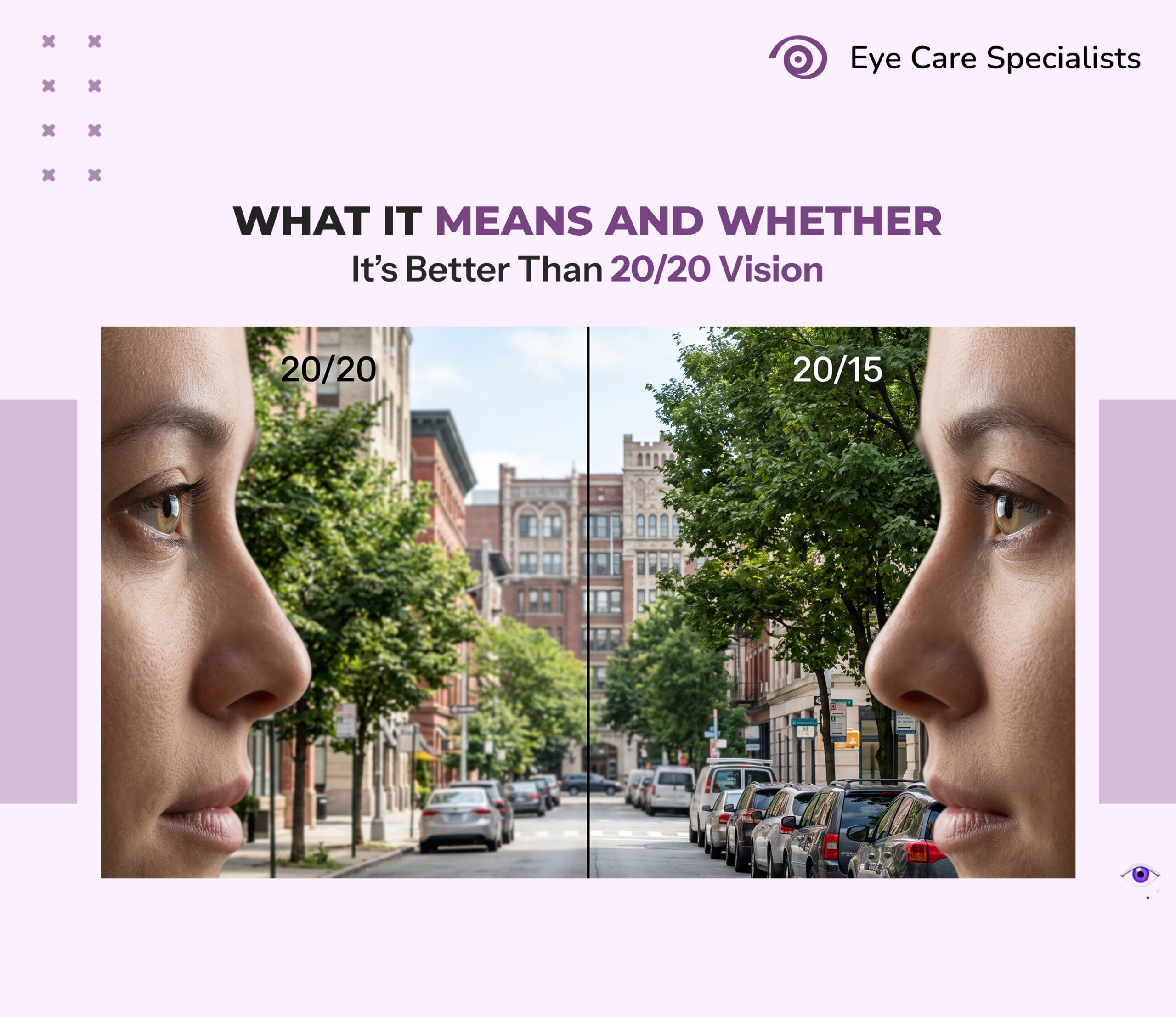
It is a visual acuity measurement that means you can see at 20 feet what someone with typical 20/20 acuity would see from 15 feet away.
In that sense, 20/15 reflects sharper distance acuity than 20/20. Still, 20/20 does not mean your eyes are “perfect.” It is simply the standard reference point for describing distance vision.
This blog looks at what the numbers mean, how 20/15 compares with 20/20, what this measurement can tell you about your eyesight, and why sharper visual acuity does not necessarily mean healthier eyes.
What Does 20/15 Vision Mean?
20/15 vision meaning refers to sharper-than-normal distance visual acuity.
It means you can see at 20 feet what a person with typical 20/20 vision would need to move to 15 feet to see clearly. In simple terms, your eyes can resolve finer details from farther away.
What Do the 20 and 15 Numbers Mean?
The first number, 20, refers to the 20-foot distance used for the eye chart test. The 15 tells you how far a person with standard 20/20 vision would need to stand to see the same letters clearly.
So, 20/15 indicates greater visual sharpness, allowing you to make out finer details from 20 feet away.
| Visual Acuity | Basic Meaning |
|---|---|
| 20/10 | You can see what a person with standard vision can see at 20 feet, not at 10 feet. |
| 20/15 | You can see what a person with standard 20/20 vision can see at 15 feet from 20 feet away. |
| 20/20 | See at 20 feet what an average person sees at 20 feet (standard normal). |
| 20/25 | See at 20 feet what an average person sees at 25 feet. |
| 20/40 | You can see what a person with 20/20 vision can see at 20 feet, but not at 40 feet. |
Is 20/15 Vision Better Than 20/20 Vision?
Yes, 20/15 vision is sharper and more defined than the traditional 20/20 standard. While 20/20 represents healthy, normal eyesight, a 20/15 rating means your eyes can see finer details clearly from a distance.
Here’s a 20/15 vs 20/20 vision comparison:
- Visual clarity: 20/15 means you can see at 20 feet what a person with 20/20 vision sees at 15 feet.
- Detail resolution: 20/15 allows you to identify smaller details than the standard 20/20 line on an eye chart.
- Reference point: 20/20 is the normal benchmark for distance visual acuity. 20/15, on the other hand, represents sharper-than-normal distance acuity.
- Overall eyesight: A 20/15 result only describes visual acuity. Neither 20/20 nor 20/15 tells you whether your peripheral vision, depth perception, color vision, or other aspects of eyesight are better.
What Difference Can 20/15 Vision Make in Everyday Life?
The main advantage of 20/15 acuity is the ability to pick out finer details from a distance. This can make certain everyday visual tasks a little easier.
Here’s how 20/15 vision influences everyday life:
- Night driving
20/15 means sharp distance vision that helps you pick out signs, pedestrians, and other objects on the road, especially at night. - Less squinting
20/15 vision allows you to see finer details clearly, which may make some tasks more comfortable. However, it doesn’t guarantee less eyestrain or fewer headaches. - Sports and outdoor activities
20/15 ensures you notice small details when playing sports or spending time outdoors. Still, activities such as baseball or golf also rely on depth perception, peripheral vision, and other visual skills. - Everyday interactions
20/15 vision offers clearer distance vision, making it easier to recognize faces or details across a room. The difference may be subtle, especially if you already have 20/20 vision.
Does Having 20/15 Vision Mean You Have Perfect Eyesight?
No, having 20/15 vision does not mean your eyesight is perfect. The result only tells you how clearly you can see details at a particular distance.
Your overall eye health also depends on other aspects of vision, such as depth perception, peripheral vision, contrast sensitivity, and color vision.
So, even with excellent distance vision, a comprehensive eye examination remains crucial to ensure your eyes are healthy and working as they should.
What Important Parts of Vision Aren’t Measured by 20/15?
A 20/15 result tells you that you can resolve fine details at a distance. However, it does not describe every part of how you see. Other visual abilities also shape how well your eyes work in everyday situations.
The following are the parts of vision that 20/15 doesn’t measure:
- Contrast Sensitivity: Distinguishing an object from its background is crucial for driving in fog or rain.
- Peripheral Awareness: Detect motion and objects outside your direct line of sight.
- Depth Perception: Judge distances and perceive three-dimensional space accurately.
- Color Vision: Accurately distinguish different hues and shades.
- Binocular Coordination: How effectively your eyes track together as a team, impacting reading comfort.
How Do Eye Doctors Know Whether You Have 20/15 Vision?
Eye doctors measure 20/15 vision with a distance visual acuity test. The test shows how well each eye can identify small letters or symbols on an eye chart from a set distance.
Ophthalmologists typically use the following steps:
- Distance eye chart: You look at a standardized chart from about 20 feet away and read the smallest line you can see clearly.
- Testing each eye: The doctor checks one eye at a time, then repeats the test with both eyes if needed. This shows whether acuity is the same in both eyes.
- Checking the 20/15 line: If you can correctly identify the smaller letters on the 20/15 line from 20 feet, your result may be recorded as 20/15.
- Testing with correction: If you wear glasses or contact lenses, the doctor may check your vision with your usual correction. It helps show how clearly you see when your refractive error is corrected.
How Common Is 20/15 Vision and Can You Have It Naturally?
Yes, you can have 20/15 vision naturally, but achieving it naturally is quite rare. Many young people with healthy eyes can read at least some letters on the 20/15 line, and some can see even smaller details.
Your cornea, lens, retina, and the way your brain processes visual information all contribute to how clearly you see. If your natural acuity falls short of 20/15, an eye doctor can assess your vision and discuss whether glasses, contacts, or another option could improve it.
Can You Achieve 20/15 Vision With Glasses, Contacts, or LASIK?
Yes, some people can achieve 20/15 acuity with glasses, contact lenses, or LASIK. Ophthalmologists often use these options to correct refractive errors that cause distant objects to appear blurred.
However, reaching 20/15 is not guaranteed and depends on your eyes and the quality of the correction.
- Custom-Fit Eyeglasses
Standard glasses bend light to correct common issues like astigmatism symptoms. If your eyes are naturally healthy, a perfectly calibrated prescription can focus light so cleanly onto your retina that you can read the tiny 20/15 line. - Contact Lenses
Contact lenses rest directly on your cornea. Hence, they eliminate the physical gap created by eyeglasses. This direct placement reduces minor optical distortions, allowing light to enter your eye more naturally for outstanding sharpness. - Custom LASIK
Modern laser vision correction uses advanced digital mapping to measure the microscopic, unique shape of your eye. By gently reshaping your cornea, eye surgeons can focus light with precision that traditional lenses often cannot match.
Should Someone With 20/20 Vision Try to Reach 20/15?
If you already have 20/20 vision and see comfortably, there is usually no reason to chase a 20/15 result.
So, is 20/15 vision good? Yes, but 20/20 already provides clear distance vision for most everyday needs. Trying to improve a healthy 20/20 result through unnecessary correction may not add any real benefit and can sometimes cause discomfort.
If you are considering LASIK to correct an existing refractive error, reaching 20/15 may be possible for some people, but the outcome varies from person to person. Your eye health and comfortable, functional vision matter more than reaching a particular line on an eye chart.
Understand Your Visual Acuity with Eye Care Specialists
Getting 20/15 vision is beyond a score. It is a profound visual enhancement that provides improved depth perception and sharper details.
Vision correction also helps with reading letters with less squinting and with comfortable night-time driving. However, if you already have standard 20/20 vision, achieving 20/15 vision means seeing an ophthalmologist.
At Eye Care Specialists, our experienced doctors are committed to offering comprehensive, personalized care to help you achieve your best possible visual outcomes.
Whether you need a routine eye examination or refractive surgery options, we are here to help you at every step.
Prioritize your vision needs by scheduling an appointment with our experts today!
20/15 Vision: FAQs
1. Is 20/10 vision better than 20/15 vision?
Yes, 20/10 vision is better than 20/15 vision. Standing 20 feet away, you can see finer details that an average person usually needs 10 feet away to see. 20/15 vision, however, helps you see things from 20 feet that are normally seen from 15 feet.
2. Can one eye have 20/15 vision while the other has 20/20 vision?
Yes, it is normal to have 20/15 vision in one eye and 20/20 vision in the other eye. It is a functionally minor refractive gap that doesn’t require any correction until one eye starts to blur or vision becomes distorted.
3. What is 20/15 vision called in the 6-meter vision measurement system?
In the metric system, 20/20 vision is written as 6/6. A 20/15 result is about 6/4.5, which means you can see at 6 meters what someone with standard 6/6 vision can see at 4.5 meters.
4. Does having 20/15 vision affect your eyeglass prescription?
Having 20/15 vision means you have sharper-than-average-distance vision. It allows you to see objects at 20 feet that you would usually see at 15 feet. While 20/15 symbolizes clearer vision, it doesn’t mean you have zero eyeglass prescription.
5. Can someone have astigmatism and still achieve 20/15 corrected vision?
Yes, a person with astigmatism can still achieve 20/15 corrected vision. Astigmatism is caused by an asymmetrical corneal shape, leading to blurriness. When they start wearing prescription eyeglasses or the eye doctor performs laser eye surgery such as LASIK, their vision reaches a 20/15 score.
6. Does 20/15 vision mean you can see better at night?
20/15 vision can help you look at things better in low light. However, it doesn’t automatically mean having 20/15 vision will make you see things better at night. It means your eyes are able to focus on light with exceptional accuracy.
7. Can prolonged screen time change your visual acuity from 20/15?
Yes, prolonged screen time can change your visual acuity from 20/15 vision. Looking at digital devices for too long can strain your eyes, causing headaches and dryness. All these alter your vision permanently and need correction with eyeglasses, contact lenses, or procedures.
8. Is 20/15 vision required for pilots or professional athletes?
20/15 vision is not legally required for pilots or professional athletes. However, the ability to see an object at 20 feet what an average person sees at 15 feet gives a competitive advantage in both fields.
9. Can children naturally have 20/15 eyesight?
Yes, children can naturally have 20/15 eyesight. It is the prime time for a person’s eye level to reach its peak performance. It means the vision is better than normal, though 20/20 is considered the standard for most adults.
10. Do you still need regular eye exams if you have 20/15 vision?
Yes, even if you have 20/15 vision, you should take regular eye exams. 20/15 vision only measures visual sharpness. However, to understand your peripheral vision or near-focusing capabilities, a thorough eye exam is crucial.