Prescription glasses support your blurry vision. However, blurred vision right after you wake up can be extremely frustrating. To reduce dependence on glasses, people often consider LASIK surgery.
LASIK (Laser-Assisted In Situ Keratomileusis) is a laser eye surgery that corrects refractive errors, including nearsightedness, farsightedness, and astigmatism, painlessly.
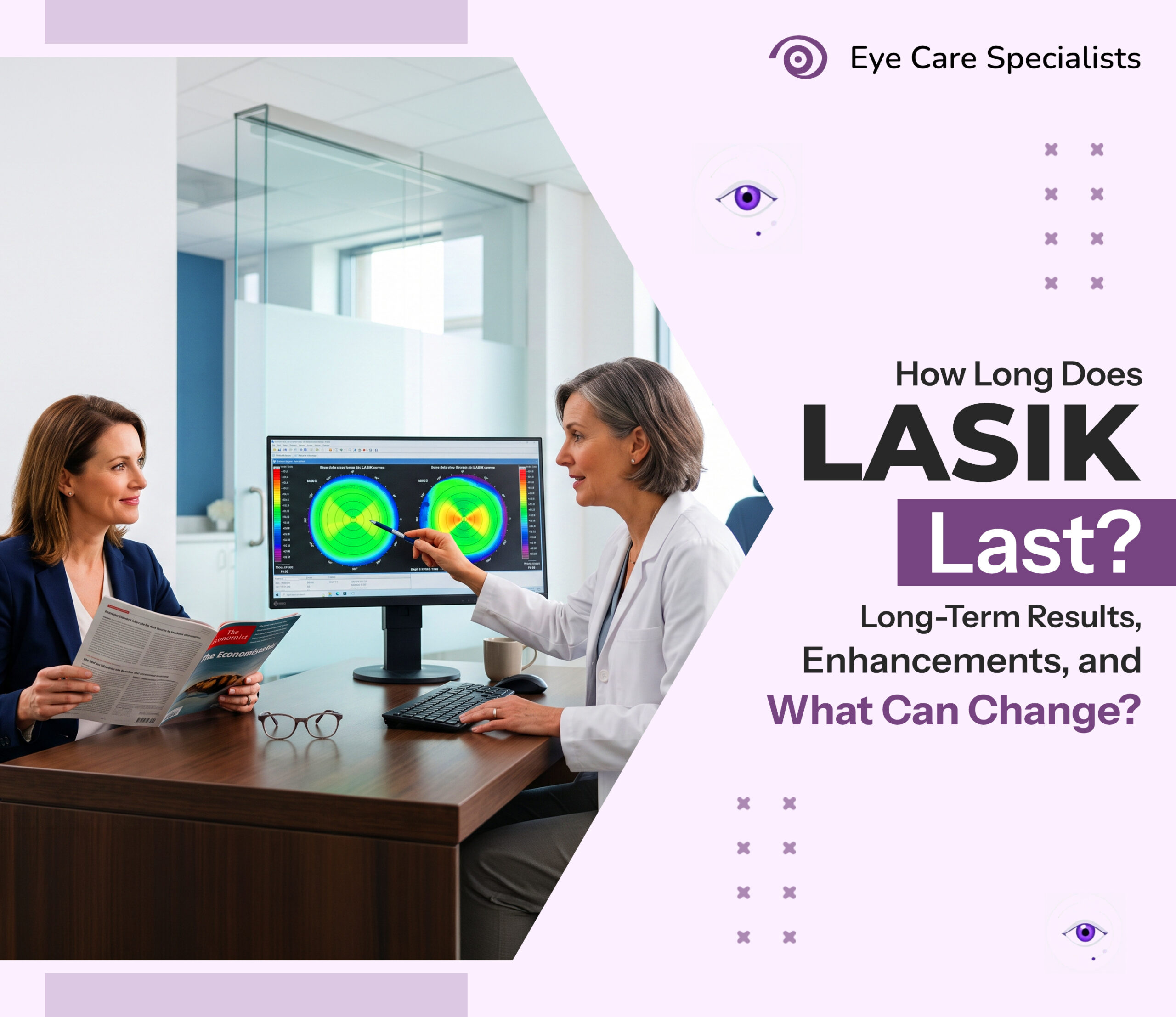
When exploring the option, people often ask: How long does LASIK last?
The short answer is that the treatment allows an ophthalmologist to permanently reshape the cornea. As a result, many patients enjoy long-lasting vision improvement for several years.
However, LASIK cannot stop the eye’s natural aging process. Some people may require reading glasses as they get older, while others can qualify for an enhancement as their vision changes with time.
This blog will tell you what to expect from LASIK over the years, why vision can change later, and when an ophthalmologist might recommend additional treatment.
Does LASIK Last Forever, or Can It Wear Off?
LASIK is a laser-based eye surgery that ophthalmologists use to reshape the cornea permanently. It means that the treatment itself doesn’t wear off. During the process, an ophthalmologist reshapes the front surface of the eye to correct refractive errors.
The process helps focus light back into the retina, and such changes remain in place for life. However, LASIK cannot prevent changes that naturally occur inside the eye over time.
As you age, the lens inside your eye loses flexibility, making it difficult to focus on nearby objects.
What does LASIK permanently change in the eye?
LASIK permanently reshapes the cornea, the clear outermost layer at the front of your eye. Ophthalmologists use an excimer laser to focus light precisely on the retina.
It thus helps improve vision affected by refractive errors. Once the cornea heals, the new shape remains fixed. For this reason, LASIK is considered a form of permanent vision correction.
Why can your vision still change if LASIK is permanent?
LASIK permanently reshapes the cornea and ensures the physical correction doesn’t wear off. However, vision still changes because the procedure cannot halt the natural aging of the eye’s internal structures.
Some patients may experience a small shift in the prescription years after the surgery. It is known as LASIK regression. The condition is likely to occur when people have high refractive errors or when the prescription was not entirely stable before LASIK.
What Long-Term LASIK Results Can Patients Expect?What Long-Term LASIK Results Can Patients Expect?
Most patients can expect clear vision years after a LASIK surgery, especially if they had a stable prescription before the surgery. The changes in corneal shape remain permanent, and many patients enjoy good vision years after the procedure.
However, the exact long-term LASIK results vary from person to person. It depends on factors like overall eye health, the degree of refractive errors, and age.
What happens in the first 3 to 6 months after LASIK?
In the first 3-6 months after LASIK, your eyes continue to heal, and your vision stabilizes. Most patients can usually expect:
Improved vision as the cornea finishes healing. Reduced dry eye symptoms, although some patients may need eye drops to keep the eyes wet for a longer period.
Decrease in night vision issues, such as glare or halos, as healing progresses.
Follow-up visits with your ophthalmologist to monitor your vision and overall eye health. A confirmation from your ophthalmologist about the success of the LASIK; however, the final healing outcome can vary from person to person.
What can happen 5, 10, or 20 years after LASIK?
After LASIK, most patients continue to enjoy good vision for years. However, your eyes continue to age, so your vision may change over time for reasons unrelated to the procedure.
Let’s see how LASIK results are in 5, 10, or 20 years:
LASIK results after 5 years
- Clear, stable vision is evident in most patients.
- Minor prescription changes may occur in some patients.
- Regular eye exams are needed to maintain overall eye health.
LASIK results after 10 years
- Most patients are less dependent on glasses for distance vision.
- Some people can find difficulty with near vision.
- Some patients may qualify for LASIK enhancement.
LASIK results 20 years later
- The new corneal shape remains, but the internal eye structure may impact vision due to age.
- Reading glasses are common because, with age, the flexibility within the eye is lost. It thus impacts near vision.
- Patients can also develop cataracts, affecting the natural lens of the eyes and vision balance.
What Can Change Your Vision Years After LASIK?
LASIK can only permanently reshape the cornea, but it cannot prevent the changes within the eye that eventually take place. Years after the procedure, your vision changes due to age or new eye conditions and not because the LASIK treatment has worn off.
The following are the vision changes after LASIK:
- The eye’s natural lens becomes less flexible with age, straining near vision.
- Clouded natural lens causing dim or blurred vision, unrelated to LASIK.
- Shifts in refractive errors, such as astigmatism or farsightedness, especially with high prescriptions before LASIK.
- Diabetic eye disease, macular disease, and glaucoma can impact vision in later life.
How does presbyopia affect LASIK patients after age 40?
Presbyopia is an age-related eye condition where an individual’s natural lens loses flexibility. When you reach around 40 years of age, you may notice focusing on nearby objects is difficult.
Even if LASIK has corrected your distance vision, you may still need reading glasses. Even a study published in the American Academy of Ophthalmology states that with or without LASIK, most people require reading glasses after around 40.
However, that doesn’t mean the LASIK has worn off. It simply means that the procedure works on the outermost layer of the front of the eye, not within.
How are cataracts different from LASIK regression?
Cataracts are a condition where the natural lens becomes cloudy. As the lens loses its clarity, vision becomes dim or blurry. LASIK regression refers to the return of refractive errors, particularly in patients with high prescriptions.
The following table will show the difference between cataracts and LASIK regression:
| Factor | Cataracts | LASIK Regression |
| What it is | Clouding of the eye’s natural lens. | Partial return of the eye’s original refractive error. |
| Cause | The most common cause is natural aging of the lens. | Mild change in the eye’s focusing power after LASIK. |
| Where it occurs | Inside the natural lens. | In the eye’s refractive system, not because the cornea “wears out”. |
| Typical symptoms | Blurry or cloudy vision, glare, faded colors, poor night vision. | Gradual return of blurry distance vision while the lens remains clear. |
| Who is affected | Common after age 60, though it can develop earlier. | A small percentage of LASIK patients, usually years after surgery. |
| Treatment | Cataract surgery with replacement of the cloudy lens. | Glasses, contact lenses, or a LASIK enhancement if the eye is healthy and the patient is a suitable candidate. |
Which factors can increase the chance of vision changes after LASIK?
Most patients who undergo LASIK have good vision afterward. However, some factors can make them more likely to experience future vision changes unrelated to the surgery.
- An unstable prescription before surgery: Vision changes are common for patients with higher prescriptions before LASIK.
- A high refractive error before treatment: If you have significant nearsightedness, astigmatism, or farsightedness, your prescription may shift over time.
- Natural aging of the eyes: Presbyopia and cataracts can affect vision years after LASIK, regardless of how successful the surgery was.
- Certain eye conditions: Diseases such as glaucoma, diabetic eye disease, or macular degeneration can change vision independently of LASIK.
- Eye injury or trauma: An injury to the eye after LASIK can affect vision and may require additional treatment.
- Hormonal changes: Pregnancy or significant hormonal fluctuations can temporarily alter vision in some individuals.
What is a LASIK enhancement?
A LASIK enhancement is a secondary procedure that fine-tunes vision when a significant change takes place in the prescription after the initial surgery. Instead of creating a new incision on the cornea, the ophthalmologist lifts the flap made during the initial LASIK.
The procedure, also known as a LASIK touch-up, reshapes the cornea to the desired prescription.
An enhancement may be considered when:
- Your vision has changed due to a slight prescription adjustment.
- Your prescription has remained stable.
- Your cornea is healthy and thick enough for additional treatment.
- Another eye condition is not causing the blurred vision.
What are the alternatives if another LASIK procedure is not right?
If another laser vision correction is not a viable option, your ophthalmologist may recommend other treatments. The other effective alternatives for LASIK are:
- PRK (Photorefractive Keratectomy): The PRK (Photorefractive Keratectomy) procedure reshapes the cornea without creating a flap. It is ideal for patients with a thin cornea.
- SMILE (Small Incision Lenticule Extraction): A minimally invasive laser procedure that reshapes the cornea through a small incision.
- RLE (Refractive Lens Exchange): Replaces the eye’s natural lens with an artificial intraocular lens (IOL) to support patients with presbyopia or farsightedness.
- Cataract Surgery: It is similar to RLE, but replacing the natural lens with an IOL takes place when the original lens becomes clouded or blurred.
How Can You Keep Your LASIK Results Stable for as Long as Possible?
LASIK may not prevent the natural aging within your eyes, but it can reshape the cornea to fix uncorrected vision. To keep the LASIK results stable for a longer period, here are some tips you should follow:
- Attend regular eye exams: Routine checkups help detect eye conditions and prescription changes early.
- Protect your eyes from UV rays: Wear UV-protective glasses after LASIK and after you’re awake to prevent uncontrolled UV exposure.
- Manage chronic health conditions: Keep conditions such as diabetes and high blood pressure under control to support long-term eye health.
- Treat dry eyes promptly: Use ophthalmologist-recommended eye drops to keep your eyes comfortable.
- Report vision changes promptly: Do not ignore persistent blurriness, glare, or difficulty seeing. Early evaluation can identify the cause and guide appropriate treatment.
- Follow your ophthalmologist’s advice: Personalized recommendations based on your eye health are the best way to preserve your vision over time.
Is LASIK Still Worth It If Your Eyes Can Change Later?
Yes, LASIK remains a worthwhile option even if vision changes take place later. The process permanently reshapes the cornea and ensures long-term independence from glasses.
Since wearing glasses is no longer a hassle, you can enjoy working at a computer or playing sports. However, it is essential to understand that the procedure doesn’t affect the eye’s structure.
So, when you age and your eyes lose their flexibility, you may require glasses. That doesn’t mean the LASIK surgery is wearing off. It means changes are taking place within the eyes that require personalized treatments.
Enjoy Long-Lasting Vision With Eye Care Specialists
So, how long does LASIK last? The answer is rather reassuring. The procedure permanently reshapes the cornea, allowing patients to reduce their dependence on glasses for years.
However, LASIK doesn’t stop the natural aging of the eyes that causes conditions like farsightedness, astigmatism, presbyopia, or cataracts. Even the prescription stability may impact vision.
It is essential to understand that even with LASIK, you would require glasses as the flexibility of your eyes decreases. But that doesn’t mean the procedure was unsuccessful.
It means you should see an ophthalmologist to determine which treatments can help with your conditions.
At Eye Care Specialists, we have a team of experienced ophthalmologists who provide a range of eye-related services. Our leading LASIK surgeons, Dr. Huan Mills and Dr. George T Frangieh, can reshape your cornea and determine its effectiveness.
Before recommending any procedure, we conduct a comprehensive eye exam to identify the cause of the issues. Our advanced technology ensures you receive the right eye surgery to help you live comfortably for a long time.
Do you want to go glass-free up to 40? Schedule an appointment with our ophthalmologists to receive the best possible treatment.
How Long Does LASIK Last: FAQ
Can LASIK make cataract surgery more difficult later?
No, LASIK does not make cataract surgery more difficult. However, your surgeon should know that you have had LASIK because it helps calculate the power of the replacement lens more accurately. Keeping your LASIK records can make this process easier.
Should I keep my LASIK records after surgery?
Yes, you should keep your LASIK records for future reference. These records can help your ophthalmologist plan treatments later in life, especially if you need cataract surgery or another vision correction procedure.
Can I wear contact lenses after LASIK if my vision changes?
Yes, if your vision changes and you are not a candidate for an enhancement, contact lenses may still be an option. Your ophthalmologist will recommend the most suitable type based on your prescription, eye health, and comfort.
Can pregnancy affect LASIK results?
Pregnancy can temporarily affect your vision. This is because hormonal changes and fluid retention influence the shape of the cornea and tear production. These changes usually improve after pregnancy or breastfeeding, but that doesn’t mean your LASIK results have permanently changed.
Can dry eyes make LASIK results seem worse?
Yes, dry eyes may worsen LASIK results. The blurry or fluctuating vision due to dryness can cause discomfort. It is therefore essential to apply eye drops as per your ophthalmologist’s recommendation to improve visual clarity.
Is a PRK enhancement the same as a LASIK enhancement?
No, both procedures refine vision, but they use different techniques. A LASIK enhancement usually involves lifting the existing corneal flap, while PRK reshapes the cornea without creating or reopening a flap. Your ophthalmologist will recommend the most appropriate option.
Can LASIK correct both distance and reading vision?
Traditional LASIK primarily corrects distance vision. It does not prevent presbyopia, which affects near vision with age. Some patients may be candidates for monovision LASIK, where one eye is corrected for distance and the other for near vision.
What symptoms years after LASIK should be checked quickly?
Severe eye pain, sudden vision imbalance, glare, and halos can come back years after LASIK. It could be because of age-related eye issues or because of new eye conditions. These symptoms may indicate a serious eye condition that requires immediate treatment.
Can one eye change more than the other after LASIK?
Yes, one eye can change more than the other over time. Age-related changes, mild prescription shifts, or certain eye conditions can affect each eye differently. A comprehensive eye examination can identify the underlying cause.
Can LASIK affect glaucoma testing?
Yes, LASIK changes the thickness and shape of the cornea, which can influence eye pressure measurements. It does not increase the risk of glaucoma, but you should always tell your ophthalmologist that you have had LASIK so your test results can be interpreted accurately.