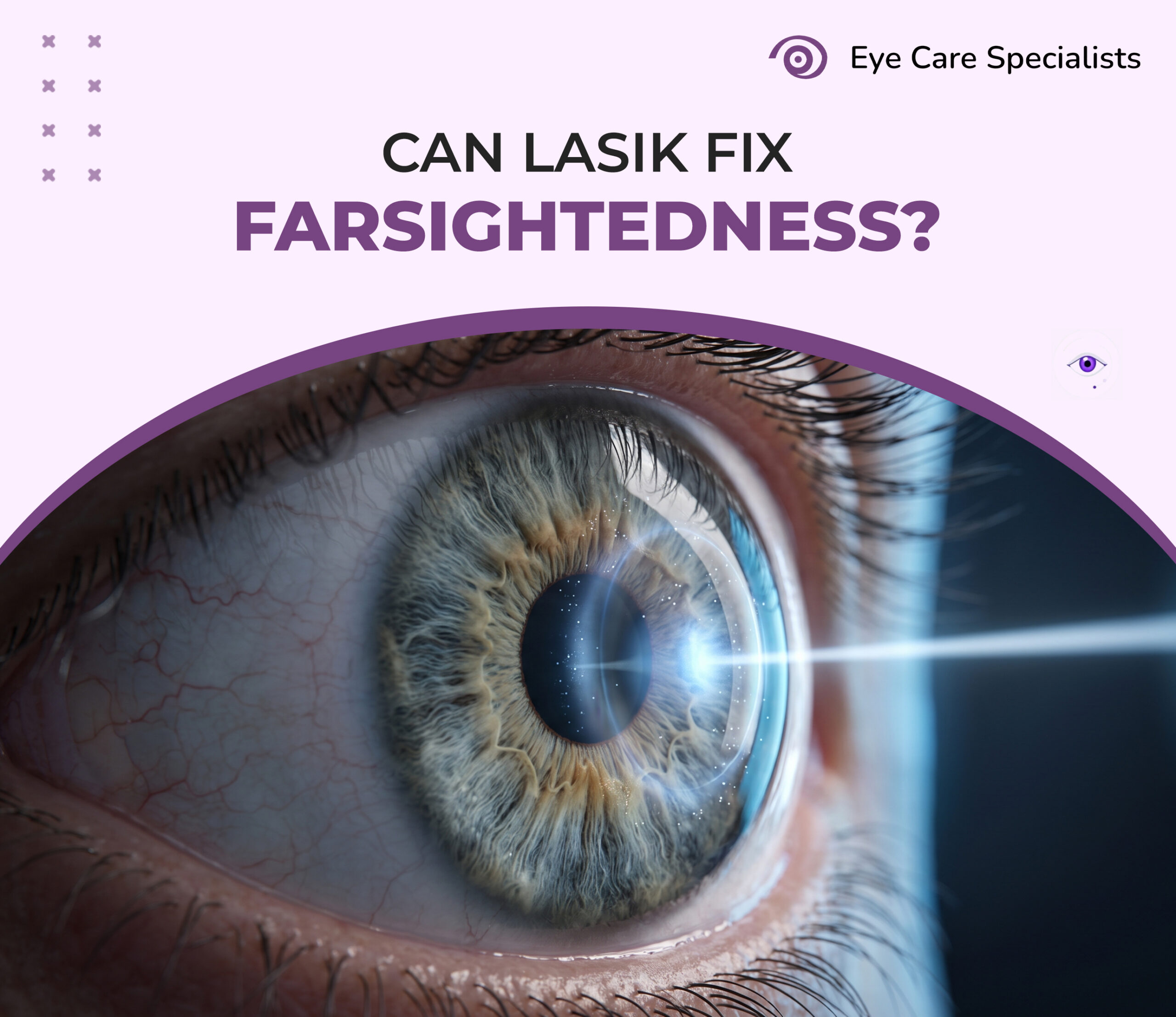
Yes, LASIK can correct farsightedness in many people, depending on their prescription and overall eye health. Farsightedness, also called hyperopia, is a refractive error that can make nearby objects appear blurry while distant objects may look clearer.
LASIK (laser-assisted in situ keratomileusis) is a vision correction procedure that reshapes the cornea to help light focus more accurately on the retina. For farsightedness, the laser steepens the central cornea, improving how the eye focuses light.
LASIK can also correct nearsightedness and astigmatism, helping reduce dependence on glasses or contact lenses. However, not everyone with hyperopia is a suitable candidate.
Age-related presbyopia, which affects near vision, can also influence whether LASIK meets your visual needs. Your prescription, corneal health, and expectations all matter when determining the right approach.
This blog explains how LASIK for farsightedness works, who may qualify, and what results you can expect. It also covers potential risks, recovery, alternatives, and whether you might still need reading glasses after surgery.
How Does LASIK Correct Farsightedness?
LASIK can correct farsightedness by reshaping the cornea so light focuses more accurately on the retina.
This laser eye surgery for farsightedness can reduce blurred vision and reduce dependence on glasses or contact lenses for eligible candidates.
Here’s how LASIK for farsighted vision works:
- Creates a thin corneal flap: During LASIK vision correction surgery, the surgeon creates a thin flap to access the underlying corneal tissue.
- Reshapes the cornea: A laser removes tiny amounts of tissue in a planned pattern, steepening the central cornea to improve its focusing power and correct the refractive error.
- Improves light focusing: The reshaped cornea helps focus light onto the retina rather than behind it, improving farsighted vision.
- Repositions the flap: The surgeon repositions the flap, and it begins healing naturally without stitches.
How Is Hyperopia Different From Presbyopia?
Hyperopia and presbyopia can both cause blurred near vision, but they develop for different reasons. Hyperopia, or farsightedness, occurs when the eye’s shape focuses light behind the retina instead of directly on it.
Presbyopia is an age-related change that makes the eye’s natural lens less flexible, reducing its ability to focus on nearby objects. While hyperopia can affect people of different ages, presbyopia typically becomes noticeable after age 40.
LASIK for hyperopia: LASIK reshapes the cornea to improve how light focuses on the retina, correcting farsightedness and potentially reducing dependence on glasses or contact lenses.
LASIK for presbyopia: LASIK cannot restore the natural lens’s flexibility. However, monovision LASIK can correct one eye for distance vision and the other for near vision, potentially reducing the need for reading glasses.
Who Is a Good Candidate for LASIK for Farsightedness?
A good candidate for LASIK for farsightedness has a stable prescription, healthy corneas, and realistic expectations. The procedure may reduce eye strain, headaches, and dependence on glasses for distance vision, though you may still need reading glasses.
Patients with dry eyes or concerns about glare and halos need careful evaluation. If LASIK is unsuitable, options such as blended vision or refractive lens exchange may be worth discussing with an ophthalmologist.
What Prescription Range Can LASIK Treat?
LASIK typically treats farsightedness up to +6.00 diopters (D), nearsightedness up to −12.00 D, and astigmatism up to approximately 5.00–6.00 D.
Typical treatment ranges include:
- Farsightedness (hyperopia): Up to approximately +6.00 diopters (D).
- Nearsightedness (myopia): Up to approximately −12.00 D.
- Astigmatism: LASIK can fix astigmatism up to approximately 5.00–6.00 D, depending on the laser system.
What Will the Surgeon Check Before Recommending LASIK?
Before recommending LASIK, the surgeon will examine your eyes, review your prescription, and check whether the procedure is suitable for you.
This assessment helps identify potential risks and set realistic expectations for vision improvement.
The surgeon will typically check:
- Prescription stability: Whether your prescription has remained stable, usually for at least a year.
- Corneal thickness and shape: Whether your cornea can be safely reshaped with a laser.
- Overall eye health: Whether you have dry eyes, infections, or other conditions that could affect healing.
- Vision needs: How well you see at near and far distances, including whether you may still need reading glasses.
- Realistic expectations: Whether LASIK can meet your vision goals and how it might affect depth perception or other visual functions.
How Successful Is LASIK for Farsightedness, and How Long Does It Last?
A study published in the Journal of Cataract & Refractive Surgery found that 94.9% of participants did not wear distance correction five years after LASIK. The study included patients with different refractive errors, so this figure is not a success rate specifically for farsightedness or a measure of freedom from reading glasses. Outcomes depend on the patient population and the type of vision correction performed.
Will You Still Need Reading Glasses, or Could Monovision Help?
Yes, you may still need reading glasses after LASIK, especially as presbyopia develops with age. Monovision LASIK can help by correcting one eye for distance vision and the other for near tasks.
However, this approach may affect depth perception, so a contact lens trial can help you decide whether it suits your daily needs.
What Are the Risks and Recovery Timeline for LASIK for Farsightedness?
LASIK for farsightedness is generally safe for suitable candidates, but like any surgery, it carries some risks. Most people notice clearer vision within a few days, while vision may stabilize over several weeks or longer as the eyes heal.
Risks of LASIK for Farsightedness
- Dry eyes: Temporary dryness, irritation, or a gritty feeling may occur after surgery.
- Glare and halos: Some people notice glare, halos around lights, or difficulty seeing clearly at night.
- Fluctuating vision: Vision may appear blurry or change during healing.
- Rare complications: Infection, inflammation, or other surgical complications can affect vision. Severe, permanent vision loss is extremely rare.
Recovery Timeline After LASIK
- First 24 hours: You may experience mild discomfort, watering, light sensitivity, or blurry vision. Rest your eyes and follow your surgeon’s instructions.
- First few days: Vision often improves enough for many people to resume normal daily activities, depending on their recovery.
- First 1–2 weeks: Vision may fluctuate, and dry eyes may persist as your eyes continue healing.
- First 1–3 months: Vision generally becomes more consistent, and stable vision may develop during this period. Some people take longer to recover fully.
What Are the Alternatives If LASIK Is Not Suitable?
If LASIK is not suitable for your eyes, other options can help correct farsightedness based on your prescription, eye health, and vision needs.
Your eye doctor can recommend the most appropriate alternative after evaluating your eyes.
| Option | How It Works and Who It May Suit |
|---|---|
| Glasses or contact lenses | Glasses and contact lenses correct farsightedness without surgery. They suit people who prefer a non-surgical option or aren’t candidates for laser vision correction. |
| PRK | Photorefractive keratectomy (PRK) reshapes the cornea with a laser, similar to LASIK, but without creating a corneal flap. It may suit some people with thinner corneas, although recovery usually takes longer. |
| Refractive lens exchange | This procedure replaces the eye’s natural lens with an artificial intraocular lens (IOL) to correct refractive errors. It may be considered for people with higher degrees of farsightedness or age-related changes in near vision. |
| Cataract surgery | Cataract surgery replaces the clouded natural lens with an artificial lens. The lens choice can also help correct farsightedness, depending on individual needs and eye health. |
Choose the Right Approach to Farsightedness with Eye Care Specialists
If you still have the question, “Can LASIK fix farsightedness?” in mind, the answer is a big yes! Laser-assisted surgery can correct it by creating a corneal flap. It also reshapes the cornea so light can reach the retina.
However, LASIK may not be right for everyone, so see an ophthalmologist.
At Eye Care Specialists, our team of doctors can help you understand your vision correction options. After a comprehensive eye assessment, we can guide you to the best option for you.
Explore our eye treatment options and take a step to correct your farsightedness.
FAQs
1. How Much Does LASIK for Farsightedness Cost?
The cost of LASIK is around $2,246 per eye. However, prices vary by location, surgeon, and technology. Your total cost may also include consultations, medications, and follow-up visits. Ask your provider for a detailed estimate.
2. Does Insurance Cover LASIK for Farsightedness?
Most health insurance plans do not cover LASIK because it is considered an elective vision correction procedure. However, some vision plans offer discounts or financing options. Check your policy and ask your provider about available payment arrangements.
3. How Long Should I Stop Wearing Contact Lenses Before My LASIK Assessment?
The recommended break depends on your contact lens type. The FDA advises stopping soft lenses for two weeks, toric soft or rigid gas-permeable lenses for three weeks, and hard lenses for four weeks before the initial assessment. Follow your surgeon’s specific instructions.
4. Can I Have LASIK If One Eye Is Farsighted and the Other Is Nearsighted?
Yes, LASIK may correct different prescriptions in each eye if your eyes are otherwise suitable. Your ophthalmologist will assess your prescription, corneal health, and how well your eyes work together. Not everyone is a suitable candidate.
5. Can I Still Have Cataract Surgery After LASIK for Farsightedness?
Yes, you can have cataract surgery after LASIK. However, previous corneal reshaping can make artificial lens power calculations more challenging. Tell your cataract surgeon about your LASIK history and bring any available records to help improve lens selection accuracy.
6. Should LASIK Be Delayed During Pregnancy or Breastfeeding?
Yes, you should generally postpone LASIK during pregnancy and breastfeeding. Hormonal changes can affect your prescription and corneal shape, making results less predictable. Your ophthalmologist can advise when your vision has stabilized enough for surgery.
7. Can LASIK Correct a Lazy Eye Caused by Childhood Farsightedness?
No, LASIK cannot directly correct amblyopia, commonly called lazy eye. It can correct the underlying farsightedness, but it cannot reverse the brain’s reduced visual development. Your ophthalmologist can assess your vision and discuss realistic treatment options.
8. Can I Wear Contact Lenses Again If I Need Them After LASIK?
Yes, you may be able to wear contact lenses after LASIK if you still need vision correction. However, corneal changes can make fitting more challenging. Wait until your surgeon confirms your eyes have healed and contact lenses are appropriate.
9. Will I Still Need Routine Eye Examinations After LASIK?
Yes, routine eye examinations remain important after LASIK. The procedure corrects refractive errors but does not prevent other eye conditions, such as glaucoma or retinal disease. Your ophthalmologist will recommend follow-up visits based on your recovery and ongoing eye health.
10. Which Symptoms After LASIK Require an Immediate Call to the Surgeon?
Contact your surgeon immediately if you experience severe eye pain, worsening or sudden vision changes, increasing redness, or new or worsening symptoms. Do not wait for your next scheduled appointment.